
An AI-generated social media plan needs evidence about the people it aims to reach, the facts it will publish, and the work a team can complete. Review each recommendation before assigning dates to the posts.
A plan might recommend daily videos, a particular platform, or a promise about audience growth. Each recommendation carries an assumption. The people you want to reach may use a different channel. Your team may have time to make one demonstration a week. A proposed event date may be wrong. A review makes those gaps visible while the plan is still easy to change.
The process below is BrandTofu’s editorial framework. It works with a plan from a chatbot, a specialist planning tool, or an agency using AI. The worked draft is fictional and written by BrandTofu. It is not output from a tested product, and its numbers are planning choices, not performance results. Sources were checked on October 25, 2026.
Give the plan a specific audience and job
Write one sentence describing the people, their situation, and what the communication should help them understand or do. A job title, city, or customer category is a starting point for this sentence. It leaves questions about language, access, experience, and intent open.
For example, a repair workshop might want nearby renters to recognize when a loose chair joint needs an assessment. A software company might want first-time team managers to understand how to read a workload report. A parks team might want residents who have never attended a guided walk to understand the route and how to join.
These goals lead to different examples and different next steps. “Build awareness among everyone nearby” gives a reviewer little basis for judging a post. “Help first-time visitors check whether this walk suits their needs” makes the missing information easier to identify.
The GOV.UK Service Manual’s guidance on user needs recommends learning how people currently complete a task, examining existing evidence, and researching assumptions. It was written for public services. The distinction between an observed need and a team’s guess also gives marketers a way to review a proposed audience.
Ask what evidence connects that audience to the recommended channel. Account analytics can describe existing followers. Customer conversations can reveal how people found the business. Questions at a front desk can reveal what visitors still need to understand. Record the scope of each observation. Five conversations can reveal a recurring obstacle; they do not measure the habits of every potential customer.
Turn recommendations into checkable statements
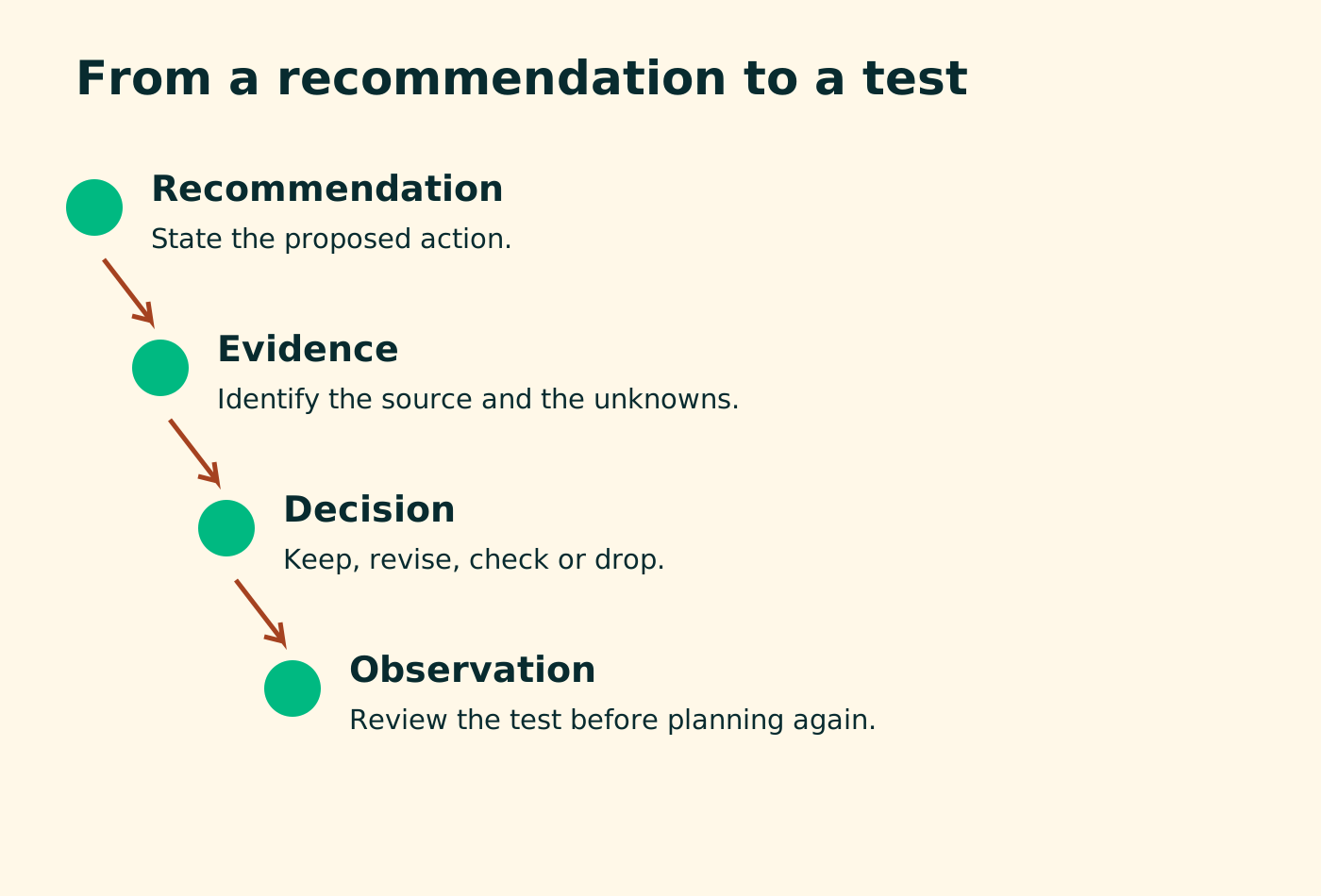
Copy each proposed action into a review record. Keep four fields beside it: the evidence, what remains unknown, the person responsible for checking it, and the decision.
Consider this fictional draft for a community garden’s introductory session:
Publish five short videos every week. Target all local adults. Promise that participants will grow a full basket of vegetables. Expect attendance to double.
The statement bundles together production capacity, audience selection, a public promise, and a forecast. Review them separately. The team may be able to film regularly, but nobody has yet checked how much editing and captioning that takes. “All local adults” includes people with very different needs. A harvest promise depends on conditions the introductory session cannot guarantee. Doubling attendance needs evidence the draft has not supplied.
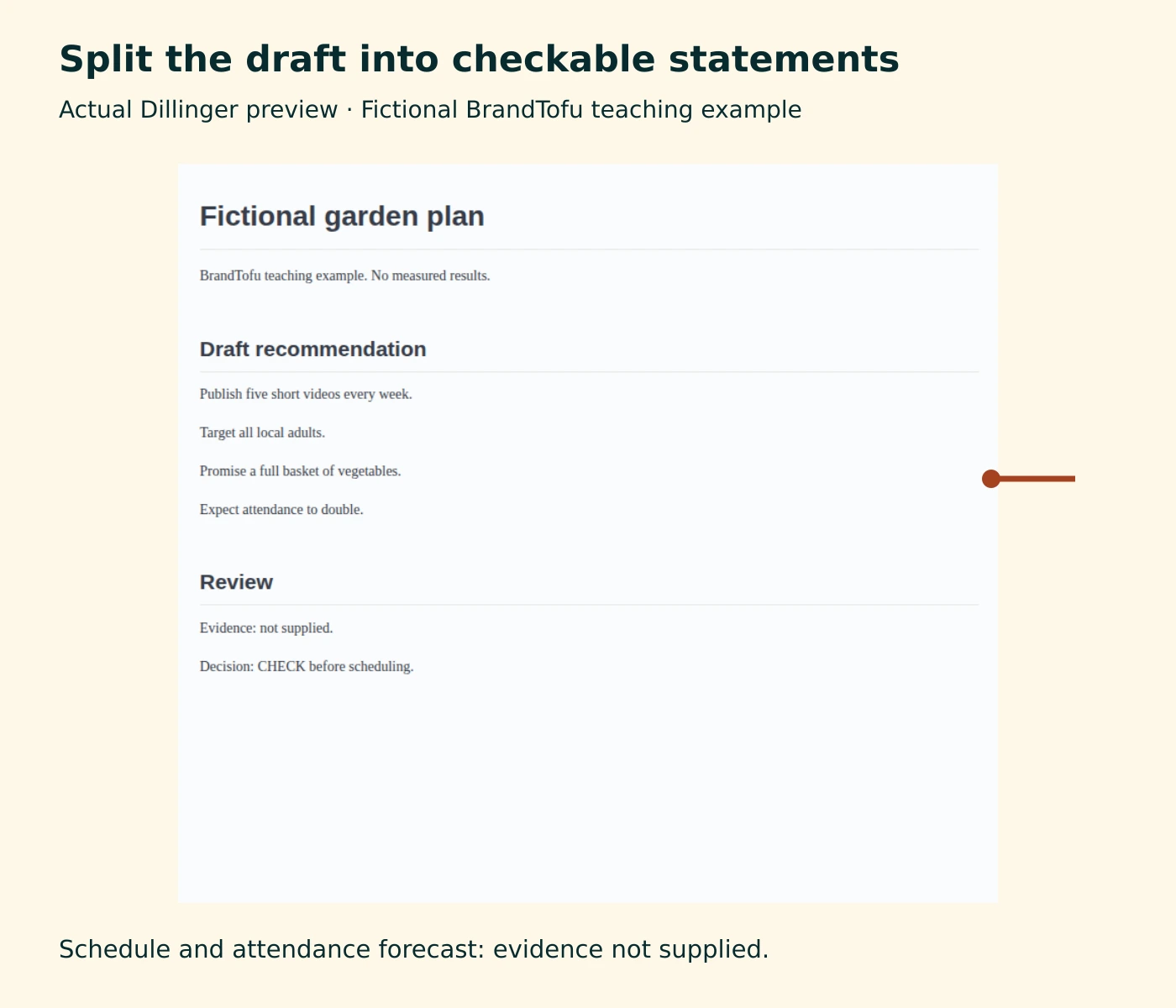
Use plain decision labels. Keep means the recommendation has enough support for its intended use. Revise means the idea can proceed after a stated change. Check means an unresolved fact or assumption needs an owner. Drop means the recommendation does not fit the goal or available resources. A recommendation marked Check stays out of the publishing queue until the check is complete.
NIST’s Generative AI Profile, published in July 2024, describes how generative systems can confidently present false content and misleading citations. Treat a citation in a generated plan as a lead to investigate. Open the original page, find the supporting passage, and check its date, population, and conditions. A genuine source can still fail to support the recommendation attached to it.
Verify facts and separate predictions from evidence
Check names, dates, prices, locations, eligibility, links, and instructions against the source that owns them. For a workshop, that may be the booking page and the organizer’s approved event brief. For a product tutorial, use the current product and documentation. For a local service, confirm the service details with the responsible team.
Keep a distinction between facts and predictions. “The session lasts an hour” can be verified against the event brief. “Short videos will double attendance” is a prediction about an outcome. A platform benchmark from another organization does not establish that result for yours.
When a forecast lacks a defensible basis, replace it with a test question. The community garden could ask whether a short route-and-arrival video helps first-time visitors find the meeting point. That creates a specific thing to observe. It does not require inventing a percentage improvement.
Preserve qualifications that affect the audience’s decision. A location change, limited access, a booking requirement, or a cost belongs in the published material when it affects participation. Check the destination after following the link as a visitor would.
Check who can receive and use the message
A social plan can describe people it will never reach. Review the gap between the intended audience and the people already following the account. If the garden wants first-time visitors, current volunteers’ reactions provide only part of the picture.
Choose ways to test the message with people in the intended situation. Show a draft to a few potential first-time visitors and ask them to explain where they would go, what they would bring, and what they expect to happen. Record misunderstandings in their own words. An approving reaction gives you less detail about comprehension than watching someone try to use the information.
Also inspect the format. Read a screenshot on a phone. Check the contrast and the text size. Review captions against the spoken words. W3C’s caption guidance explains that captions provide synchronized text for speech and the other audio needed to understand a video. A decorative headline on a video serves a different purpose and may leave the explanation inaccessible.
For public communications, discuss language, access, and offline routes with the responsible team. For a business, consider people who are discovering the category for the first time. For a creator, consider what a new reader needs to understand before following a series. State any audience gaps the test will leave open.
Replace the calendar with a test the team can run
Give the first test a bounded scope. Specify one audience situation, one message, one primary channel, a production limit, and a review date. These are choices for your organization to make using its resources and evidence. A generated plan’s confidence cannot set them for you.
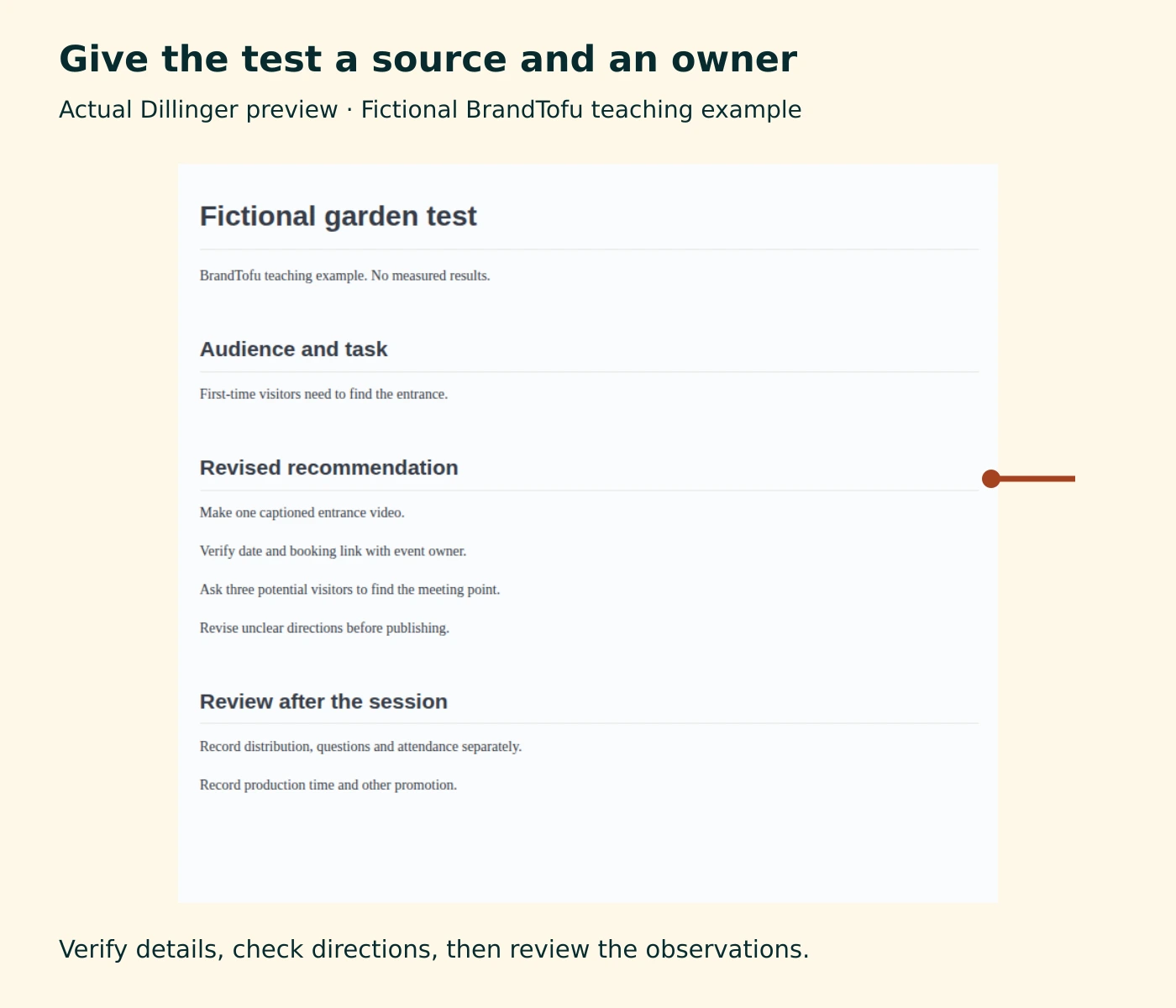
The fictional garden draft could become:
Make one captioned video showing the entrance and meeting point for the introductory walk. Use the approved event brief for the date and booking link. Ask three potential first-time visitors to find the meeting point using the draft. Revise any unclear directions before publishing. Review questions and attendance records after the session.
The three-person check is an illustrative usability exercise, not a representative survey. It can expose a confusing direction. It cannot establish how many residents understood the campaign or prove that the video caused attendance.
Record the starting conditions before publication. Save the approved post and its live URL, the event details, the account’s available distribution information, and any comparable prior observations. Keep known differences visible. A change in weather, capacity, timing, or partner promotion can affect an event’s attendance.
The CDC’s communication planning guidance connects objectives, audiences, channels, responsibilities, message testing, and evaluation. It describes a planning process for public health programs; it does not establish a posting frequency or growth benchmark for a business. Its planning components help explain why a calendar alone leaves several decisions unfinished.
Decide what the observations allow you to change
Review delivery, understanding, and action separately. Distribution data describes where the post appeared or how people encountered it. Draft testing and follow-up questions can reveal comprehension. Registrations or visits describe subsequent actions. Each observation answers a different question.
Suppose the draft viewers find the entrance but ask whether children can join. Add the verified participation details before publication. Suppose the live post receives questions from existing volunteers and reaches few newcomers. Investigate distribution to the intended audience. Suppose attendance rises after a partner also shares the event. Record both activities and the limits of attribution.
Keep production time in the record. If a single video consumes the team’s available week, a five-video schedule needs a different process or a smaller scope. Keep the next decision concrete: clarify directions, test a still image, seek a relevant partner’s permission to share, or repeat the same format with another audience question.
Ask planning tools to show what they still need
A public question from Aidan Evans asked what to consider when building a tool that would create a municipal social plan from a person’s role and city. It illustrates a broader design question: which facts can a planning system know, and which ones must the user supply or verify?
If you build or commission a planning tool, ask it to keep supplied facts, sourced observations, and assumptions distinguishable. Missing evidence should produce a question or a Check decision. Let people correct the audience, objective, constraints, and facts before the tool produces a calendar. Keep the source and review date beside changeable details.
Save the reviewed version with its owner and next review date. When an event, product, audience need, or team capacity changes, reopen the affected recommendations and update the evidence before scheduling the next batch.