
Choosing social-media marketing help starts with a description of the work your business needs. Define the people you want to reach, what they should understand, and the next step they can take. Ask prospective providers to respond to the same brief. Then compare their responsibilities, evidence, costs, and demands on your time.
A package containing eight posts and a package containing four posts plus filming cover different work. The post count alone gives you little information about which one fits your business. A comparison becomes clearer when you can see who develops the ideas, supplies the material, approves the claims, publishes the work, and answers people who respond.
This is BrandTofu's editorial framework for choosing external marketing support. The repair-studio examples and provider proposals below are fictional. Platform documentation and the demonstrated whiteboard were checked on November 1, 2026.
Describe the audience and the job
Start with the circumstances that bring people to your business. A furniture-repair studio might serve nearby households deciding whether to repair a damaged chair. A software consultancy might serve operations teams struggling with repeated handoff errors. An accounting firm might serve owners who need to understand when their current bookkeeping process has become difficult to manage.
For each, educational content can introduce the business by explaining a recognizable problem. The repair studio could show how to photograph a loose joint before requesting an assessment. That lesson needs an accurate demonstration, a clear explanation of the service area, and a working route for sending an enquiry.
Write the outcome you want to investigate in language you can check. “Help nearby households understand our repair service and send relevant assessment enquiries” gives a provider more direction than “grow our social media.” It also makes responsibilities beyond posting visible: someone must review the enquiries and respond.
The U.S. Small Business Administration's marketing guidance connects a marketing plan with the target market, competitive advantage, sales process, goals, actions, and budget. Use those connections when preparing your brief. Your business's offer and capacity should inform the campaign.
A first brief can fit on one page:
- Audience and situation: who needs the service and what they are trying to decide.
- Offer and destination: what the business provides and where people can inspect the details or enquire.
- Starting point: current channels, available material, past activity, and known problems.
- Work requested: research, planning, writing, design, recording, publishing, replies, and reporting.
- Resources: spending range, people available, approval time, and material you can supply.
- Review: the evidence you want to see and the date you will discuss the next decision.
Give providers the same starting information. Invite them to explain where the brief needs revision and what they would investigate first. A reasoned objection can show how they approach the work.
Match the support to your missing capacity
A strategist helps choose the audience, message, channels, and tests. A content producer makes the writing, images, or videos. A social-media manager may handle publishing and participation. A specialist might run paid campaigns or measurement. Providers combine these activities in different ways, so ask what their own package includes.
If you already know what customers ask and have approved material, publishing support may resolve the immediate workload. If the audience and offer remain unclear, a batch of finished posts will carry those unresolved choices into the feed. If filming is the bottleneck, check whether the provider captures material or expects you to supply it.
The choice between an individual and an agency follows those responsibilities. An individual can fit a focused task with a clear owner. An agency may provide several disciplines and cover for absences. Check the actual people assigned to the account, their responsibilities, and who takes over when somebody is unavailable. The label on the proposal does not establish those arrangements.
This article began with a business owner's public request for marketing support. She wanted help with content, social management, strategy, visibility, and new enquiries for an accounting firm. Those are connected activities with several possible owners. The same briefing problem appears in local services, consulting, retail, and software businesses.
Compare proposals against the same work
Put each provider's answer beside your brief. Record included work, excluded work, owner input, and unanswered questions. Keep an unknown marked as unknown until the provider clarifies it.
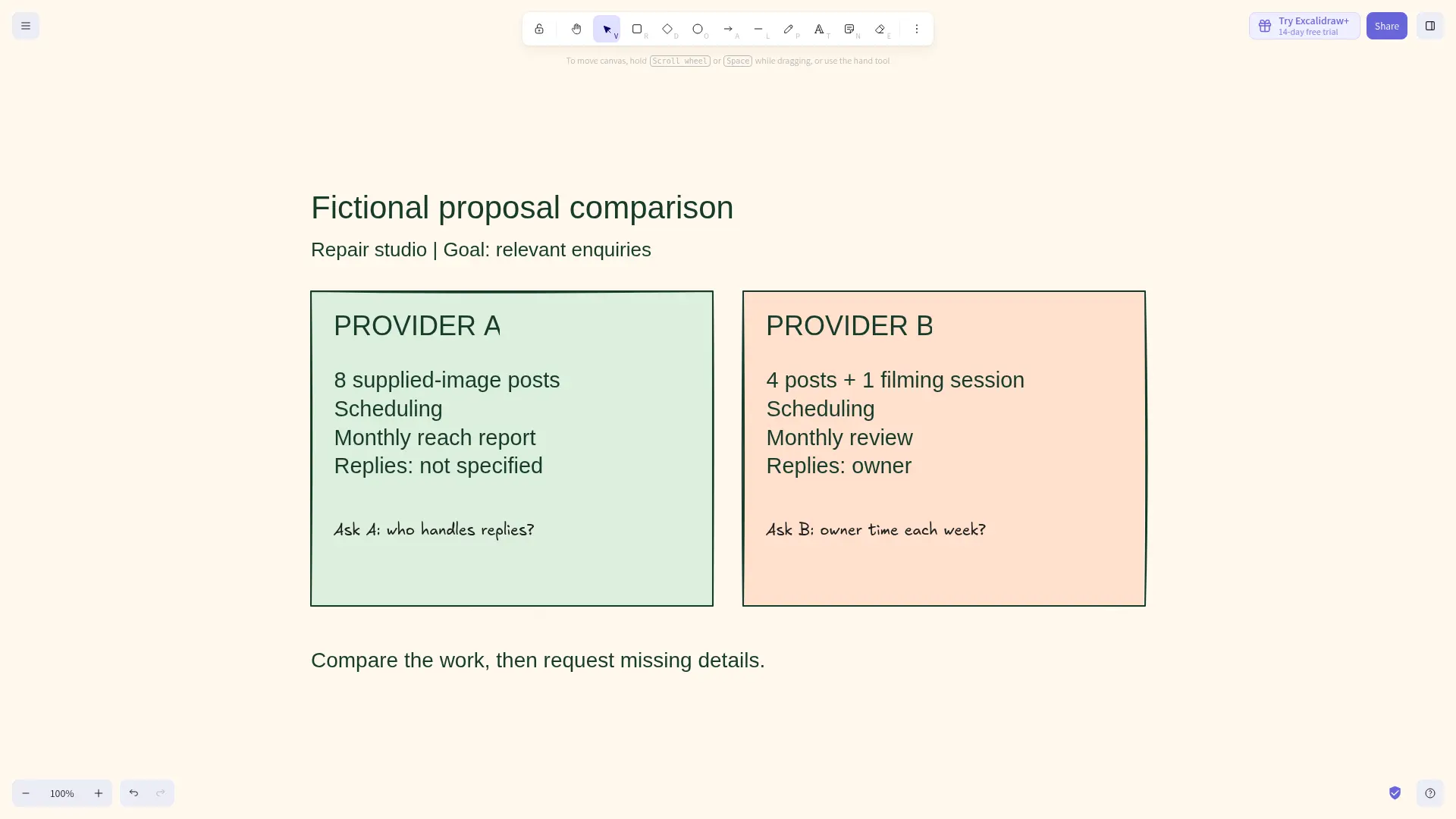
Our fictional repair studio receives two proposals. Provider A offers eight supplied-image posts, scheduling, and a monthly reach report. Provider B offers four posts, one filming session, scheduling, and a monthly review. B assigns replies to the business owner. A leaves replies unspecified.
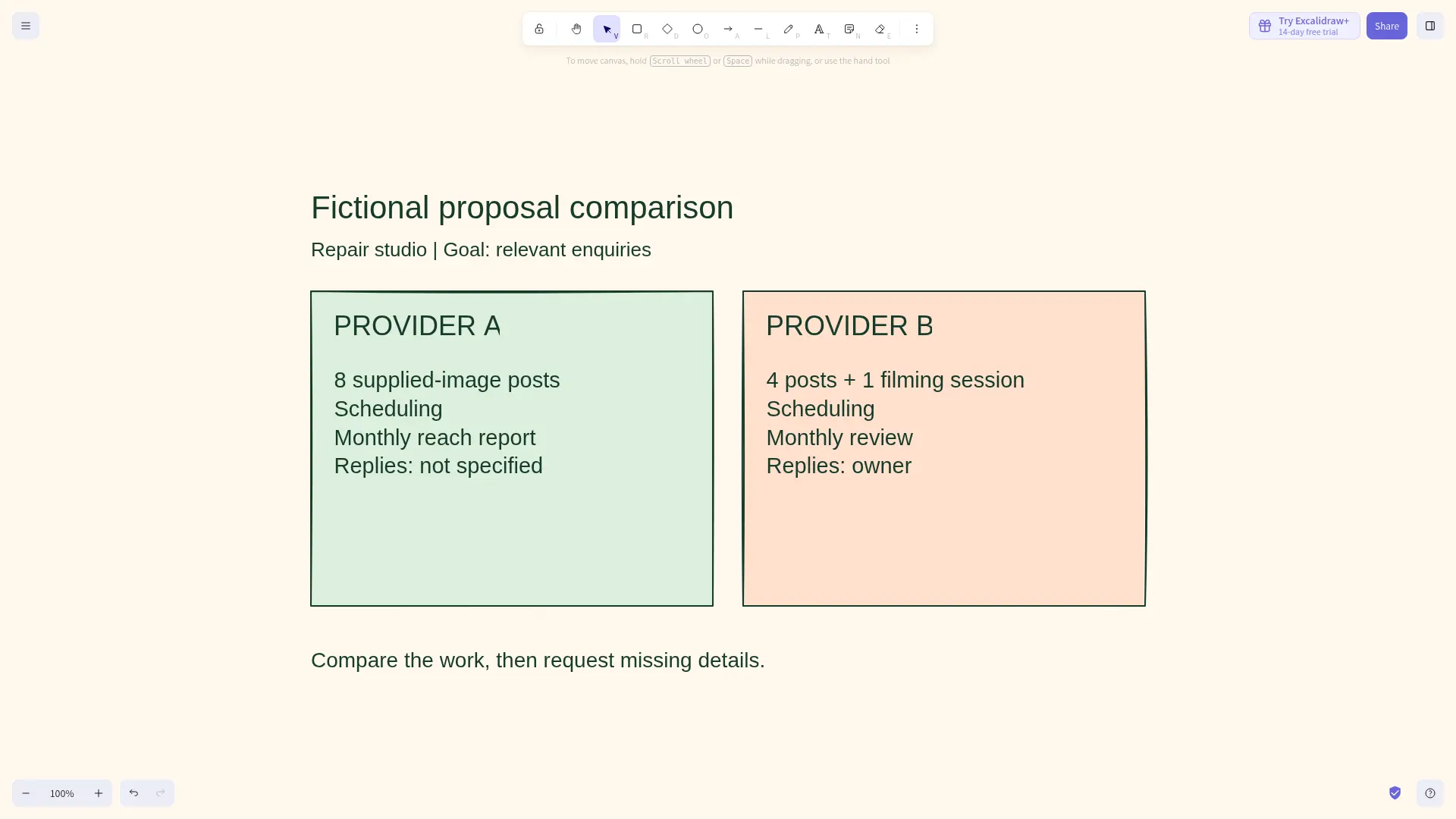
The example uses Excalidraw's browser whiteboard. Its public editor let us open and edit this drawing with no signup or payment. We used its text tool to add two questions beside the proposals. The project documents its open drawing format and export options, so you can retain an editable local copy. The paid Excalidraw+ service is separate from this demonstrated task.
Ask A who handles replies. Ask B how much owner time filming, approvals, and replies require each week. Neither answer alone chooses the provider. They establish whether the proposed division of work fits the studio's capacity.
Ask both providers to specify the number of original assets, channel versions, revision rounds, approval deadlines, and publishing checks. Check whether paid-media spend, travel, software, photography, and extra revisions are included in the fee. For video, confirm what source footage and editable files the business receives.
Keep price beside the complete scope. A lower fee can still require substantial work from your team. A larger package may include activities you cannot use yet. Compare the total commitment: provider charges, media spending, other expenses, and internal time.
Ask for evidence you can examine
Request one comparable project and ask the provider to walk through it. Find out who the audience was, what the business needed, what the provider personally did, what resources were available, and how the result was measured. Ask permission to contact a reference who can discuss the working process.
A portfolio image can demonstrate design work. A published video can show the quality of an explanation. A campaign report can show delivery under a defined measurement method. Each supports a different conclusion. Ask for the evidence that matches the capability you need.
For a claim about new customers, ask about the period, starting point, spending, definition of a customer, and other changes happening at the business. An enquiry is a person contacting the business; a relevant enquiry also meets criteria you define, such as service area and type of work. A customer has completed the business's purchase process. Keep those counts separate.
A provider may have credible work in another industry. Ask how they will learn your customers' questions, review specialist claims, and recognize a suitable enquiry. For the accounting-firm example, topic accuracy and client confidentiality need an approval process. For a repair studio, claims about what can be repaired need review by the people who assess the furniture.
Give the provider a paid, bounded exercise when a proposal leaves a capability uncertain. For example, ask for one lesson brief and one finished post based on approved public material. Agree on the fee, permitted use, review criteria, and deliverable before the exercise begins. It should resemble the work you expect to commission.
Agree on access, approvals, and handover
Keep the business's accounts and assets under business control. Record which accounts exist, who can manage access, which tasks the provider needs to perform, and how access will end. Use each platform's role controls and review them against the agreed work.
LinkedIn's Page administration guidance describes adding a person with a selected admin role. Its role descriptions distinguish content management from broader administration. Choose the role from the tasks the person will carry out, and check the current account options before granting it.
Google Analytics documents separate access roles and data restrictions. Viewing reports, changing property settings, and managing users are different permissions. Ask a provider to explain the access needed for the reporting work in the proposal.
Agree who checks facts, customer permissions, brand language, and the final post. Set an approval deadline that your team can meet. Decide who answers ordinary questions and when a response needs to go to the business owner.
Include handover in the working arrangement: approved source files, current briefs, live post URLs, reporting exports, account responsibilities, and unresolved tasks. Confirm how the business will continue using the material when the engagement ends. Discuss these details before production, while both sides can revise the scope.
Review one complete trial
Choose a trial long enough to complete the agreed work and observe the response relevant to your question. There is no universal number of days that establishes marketing success. A local event campaign and a consultancy's educational series have different production schedules and buying cycles.
At the review, examine the work and its consequences. Were the agreed assets delivered, accurate, approved, and published correctly? Could relevant people understand the offer and take the intended next step? What questions or enquiries arrived? How much time did the business spend supplying material, reviewing, and replying?
Read the report with the original brief beside it. Reach describes exposure under the platform's definition. Questions and enquiries can reveal audience fit and understanding. Customer records can show completed business actions. These observations help choose the next test; a sale after a post alone does not establish that the post caused it.
An operational problem may call for a revised scope. Repeated late approvals may need a different review arrangement. Enquiries from outside the service area may need a clearer message or distribution plan. A production process that works and draws relevant questions may justify another agreed period with one specific change.
Keep the brief, clarified proposal, trial work, response record, and next decision together. Use that record when deciding whether to continue, revise the responsibilities, or choose another provider.