
Publishing a method lets readers try your work for themselves. Some may become customers. Some may use the lesson and never hire you. Decide whether that exchange supports your business before releasing the material.
Define a complete result the reader can reach and describe what your paid service supplies. Check permission for the material you use. You can teach a small task thoroughly while keeping a client's records, an unreleased campaign, or a separately sold asset out of the example.
Choose a reader task you can finish teaching
Write the result in the reader's language. “Choose a subject for your next customer interview” is a task. “Understand our strategic approach” leaves the reader guessing about what they will learn.
Choose a scope you can explain from start to finish. A photography studio could teach someone to check a product photo for glare. A marketing consultant could show how to separate an observed action from an interpretation. A workshop host could explain how to write a session invitation with a clear learning outcome.
Include the starting material, the steps, a worked result, and the checks that tell the reader whether it worked. If a necessary step sits behind a paid offer, describe that boundary before asking the reader to begin. A tutorial that promises completion should supply the steps needed for its stated task.
The 2025 Edelman–LinkedIn thought leadership study surveyed nearly 2,000 professionals about business buying. Its findings support giving buyers material that reveals how a supplier thinks. They do not establish how much of your particular method to release, or prove that a tutorial will bring you customers. Treat the publishing boundary as a decision to test in your own business.
Check the material separately from the idea
A general lesson and the records used to explain it can have different sharing permissions. Review the actual files, screenshots, quotations, and examples before publication.
For each item, record its owner, the permission you have, the intended audience, and any limits. A customer's approval to discuss a project does not tell you which screenshot they approved. Ask about the exact material and proposed use. When that answer is pending, leave the item out of the public draft.
GitLab's public confidentiality guidance illustrates how an organization can publish extensive working knowledge while defining categories that stay internal. Its categories belong to GitLab. Your review needs to follow your own agreements, policies, and the material owner's decisions.
For a worked example, fictional teaching data can carry the explanation. Label it at the point of use. Build the example afresh so that names, numbers, file titles, account details, and the shape of a distinctive case do not reveal a real client. A blurred name on an otherwise identifiable screenshot may leave the person or company recognizable.
Write down what someone buys from you
Compare the public lesson with the paid deliverable. Be specific about the work in each.
In a fictional example, a consultant plans to publish a tutorial about organizing interview notes. The tutorial teaches readers to record an observation, propose an explanation, and choose a follow-up question. The paid engagement includes recruiting participants, conducting interviews, checking competing explanations, and helping the team make a decision.
Those are distinct scopes. The tutorial still needs to teach its note-taking task completely. The service description needs to explain the additional work and who needs it.
The decision changes if the product for sale is the exact worksheet, a short configuration recipe, or a course whose main deliverable is the same tutorial. A full public release may supply the thing a customer would otherwise buy. That can be an intentional distribution choice, but write down the consequence before making it.
Do not assume that everyone who uses the free material would never have paid. Do not assume every reader would have become a customer either. Both claims require evidence you usually lack at the planning stage.
Public depth can also be a deliberate part of a business. 37signals offers its Shape Up book to read online and download while selling software and print books. That is an example of an explicit publishing choice. It does not predict the result for a consultant selling a tactical recipe.
Make the publishing decision visible
Use a short review record for each proposed lesson:
- State the reader task and the finished result.
- Identify the material and confirm what you can publish.
- Describe the overlap with a paid deliverable.
- Choose the public version, the person responsible, and a review date.
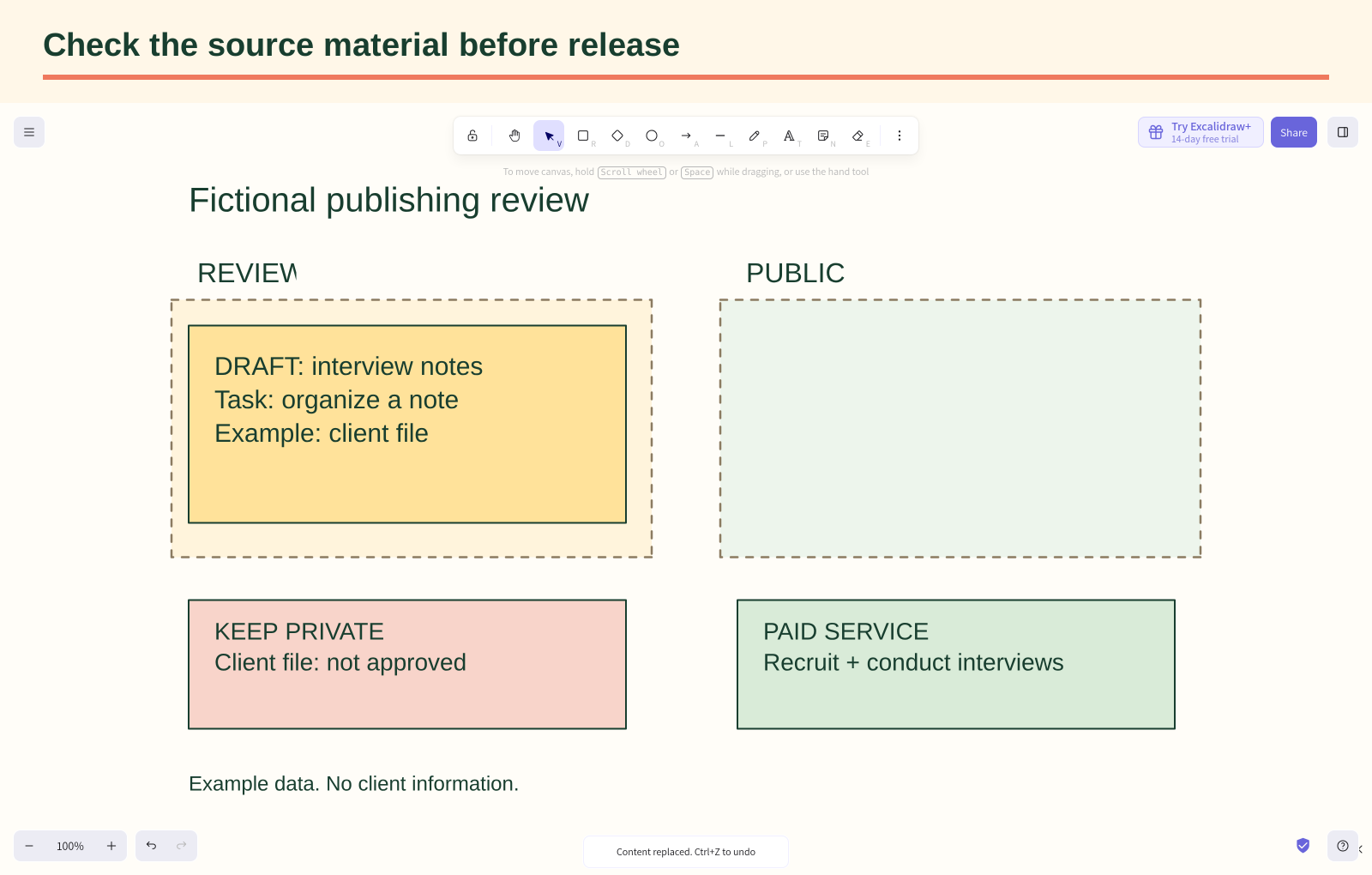
The example uses Excalidraw's free browser editor. As checked on November 6, 2026, the official free plan includes an infinite scene, drawing tools, and file export. A paid cloud workspace is a separate option. The anonymous editor was available for this demonstration. You can keep the same review record in a document or your team's existing project tool.
In the recording, the starting board contains a proposed interview-note lesson and a separate client-file card. The review keeps the client file outside the public lesson and replaces the example with fictional notes. The lesson's finished result is a note with an observation, an explanation to check, and a next question.
The tutorial could then work through this fictional example. A participant reads the delivery page twice and asks whether delivery includes carrying the product upstairs. Record that action and question as the observation. Write “the delivery scope may be unclear” as an explanation to check. A follow-up question could ask the participant to describe what they expected the delivery service to include. The rereading alone does not establish why the participant paused. Keep that uncertainty visible in the note, then compare it with further observations before changing the page.
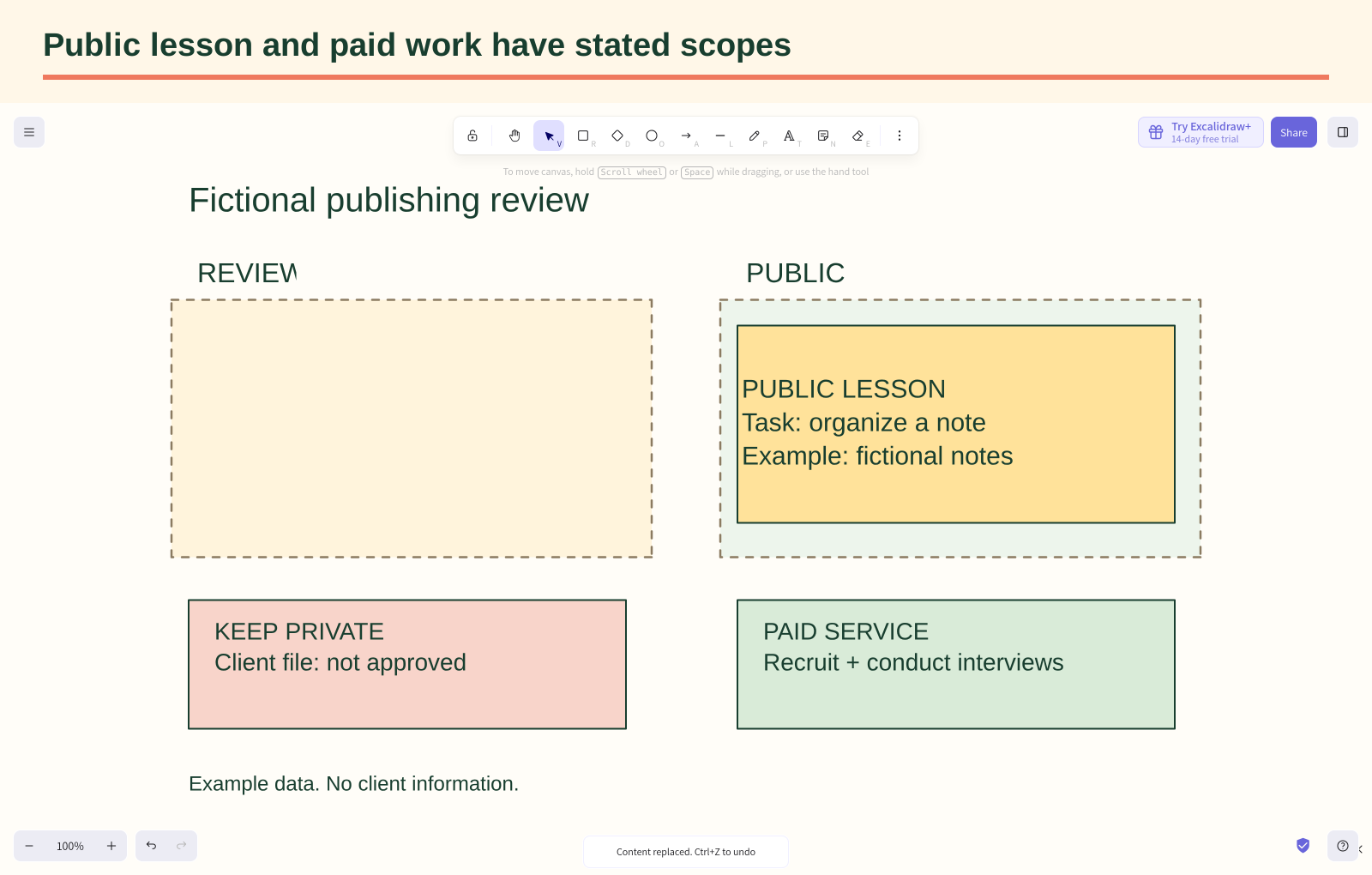
This board records an editorial decision. It contains no campaign results or evidence that the lesson has attracted customers.
Match the boundary to the format
Different teaching formats expose different parts of the work:
- A tutorial should teach the stated task, including prerequisites and the result check. Show where a tool, version, or example limits the steps.
- A template should explain its fields and include a filled example. Decide explicitly whether you are distributing the same asset you sell.
- A case study needs approved material and a clear account of your contribution. Report measured results with their period and scope. Label reconstructed or fictional examples.
- A workshop can teach a bounded task and offer feedback. State preparation, time, and what participants will finish.
- A public process guide can explain decisions, trade-offs, and the work sequence. Remove confidential inputs and check that the remaining explanation still makes sense.
This article began with Dan Sanchez's LinkedIn discussion about sharing marketing tactics. His concern was that readers could use automated tools to reproduce an approach that previously took more effort to learn. That concern changes the trade-off for some offers. It does not establish that every tool can reproduce every implementation, or that keeping a method private will preserve demand.
For planning, assume a public lesson can be reused. Then choose what you are willing to distribute, and make the lesson accurate enough to stand on its own.
Test comprehension and commercial response separately
Before publishing, ask a few people from the intended audience to try the lesson. Give them the task and observe where they need help. The Government Digital Service's moderated testing guidance describes this task-based approach. Here, it checks the lesson's instructions and result. It cannot estimate the market's willingness to buy your service.
Ask what the person can now do, which steps remain unclear, and what they believe your paid service includes. If they mistake the lesson for the entire engagement, revise the service description. If the lesson omits a necessary step, repair the lesson.
After release, record responses over a defined period: relevant questions, examples of people applying the method, inquiries about the paid work, production time, and any permission issues. Ask new inquiries which material they encountered and what help they need. Keep their own account separate from your attribution assumptions.
Choose the next action from those observations. Readers who cannot finish the task need a clearer example. Readers who finish it and ask for implementation may need a more precise service scope. If public distribution repeatedly supplies the same deliverable you charge for, review the offer and the release policy together.