
Founder content can introduce a company through the problems its founder understands, the decisions behind its work, and a clear explanation of its offer. Choose a reader, show something they can use or assess, and give interested people a route to the relevant product or service.
A founder may also write about family, hobbies, professional life, or the experience of running a business. Those subjects can serve different readers. When a post is meant to help someone discover the company, make its connection to that person's situation visible.
The process below is BrandTofu's editorial framework. The worked examples are fictional. Sources and the demonstrated editor were checked on October 28, 2026.
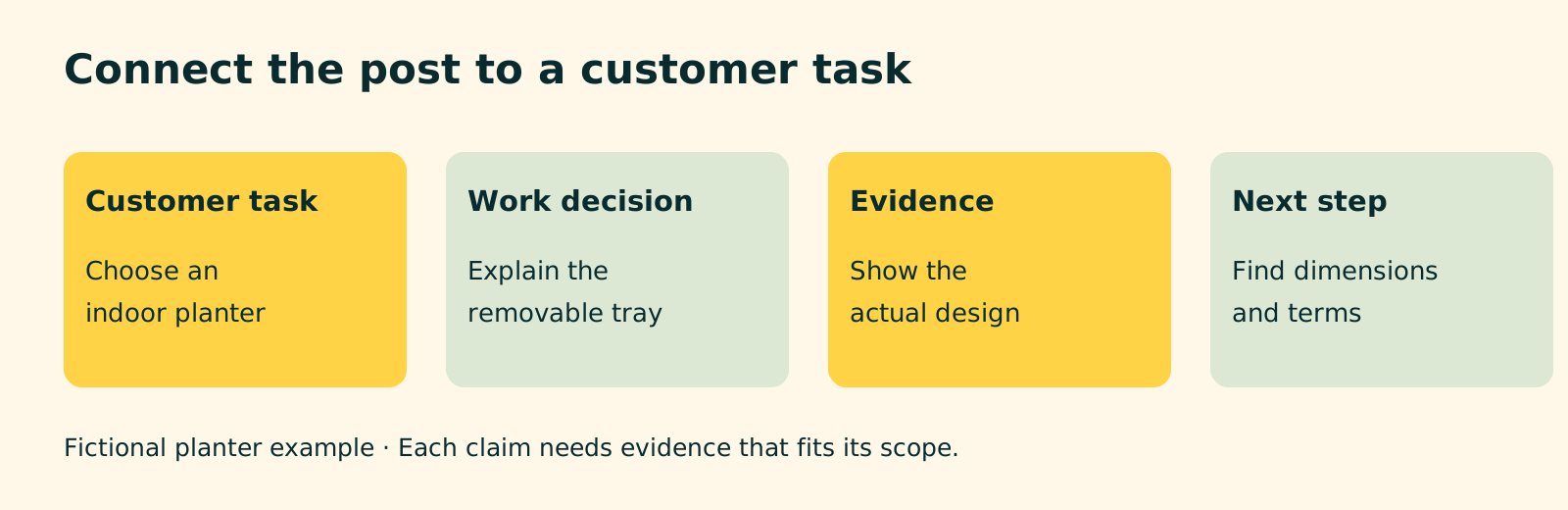
Find the overlap between your experience and the customer's task
Write two sentences before choosing a topic: who might need the company's offer, and what they are trying to do when that need appears. Then identify an experience you can explain that helps with that task.
A founder making planters might know how tray design affects emptying collected water. An independent garden-shop owner might need to explain that design to a customer choosing an indoor planter. That is an overlap: the founder can show a decision the retailer needs to understand.
For a software founder, the overlap could be how a small operations team handles a missed handoff. For a studio owner, it could be how a restaurant makes a menu readable in dim light. The founder's internal fundraising process may interest fellow founders while serving a different purpose from those customer lessons.
April Dunford's positioning primer connects customer alternatives, capabilities, value, customer fit, and market category. It helps you define whose circumstances make a capability relevant. Our application to founder posts is to begin with one of those circumstances and explain the work through it.
If the overlap is uncertain, talk to people who resemble the intended reader. Ask them to describe the last time they faced the task, what they tried, and what made the decision difficult. GOV.UK's interview guidance recommends open, neutral questions and concrete experiences. A few conversations can reveal topics to investigate; they cannot establish how common a problem is across the market.
Give each post a clear purpose
A post might teach a task, show evidence of a capability, explain a decision, or invite someone to consider an offer. Decide which job the next post should do. The purpose helps you choose what belongs in it and what response you will examine.
A teaching post could explain how to measure a windowsill before choosing a planter. A process post could show the dimensions that changed between two prototypes. An offer post could state which shops the maker supplies, link to product specifications, and explain how to request wholesale terms.
Personal observations can remain part of the mix. A story about visiting a shop becomes commercially relevant when it explains an actual customer problem or a decision you can support. Keep private experiences private when they add no necessary context. Ask permission before sharing another person's story, image, or identifiable work.
The 2025 Edelman–LinkedIn B2B Thought Leadership Impact Report examines how business content influences visible and less visible members of buying groups. Its survey concerns B2B professionals. Its findings provide context for reaching people involved in decisions. They do not forecast the response to an individual founder's posts. It does not establish a universal ratio of personal, educational, and promotional content.
Choose a mix your team can produce and review. For example, a founder could test a customer lesson, a documented work decision, and an explicit offer over a manageable period. That is a sample plan. Select the period and number of posts from your publishing capacity and the time needed for relevant people to encounter them.
Turn a general update into an inspectable example
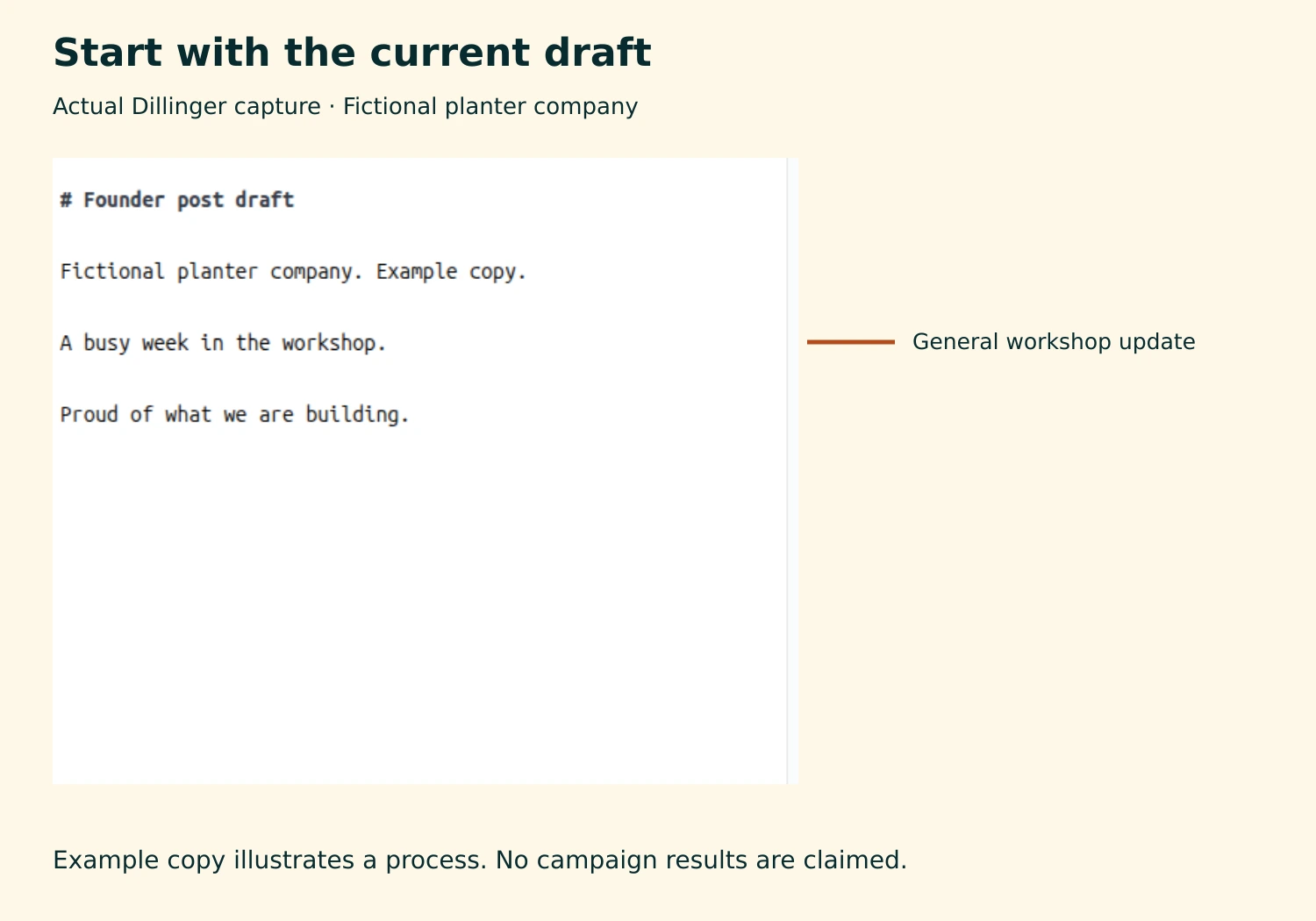
The initial draft in our worked example reads: “A busy week in the workshop. Proud of what we are building.” A follower can understand the founder's mood. A garden-shop owner has little information to use when choosing or explaining the product.
We revise the draft in Dillinger, a public Markdown editor. Markdown is plain text with simple marks for headings and other formatting. Dillinger lets us inspect the draft and its formatted preview side by side. The demonstrated editing function is available with no signup or payment; no cloud account is connected. The editor organizes the text. It does not evaluate the marketing claim.
The fictional revision names the reader, then describes one decision: “We added a removable tray so customers can empty collected water.” It asks the maker to show the design and explain its limits. A real company would replace this exercise with an actual product, verified specifications, and approved images.
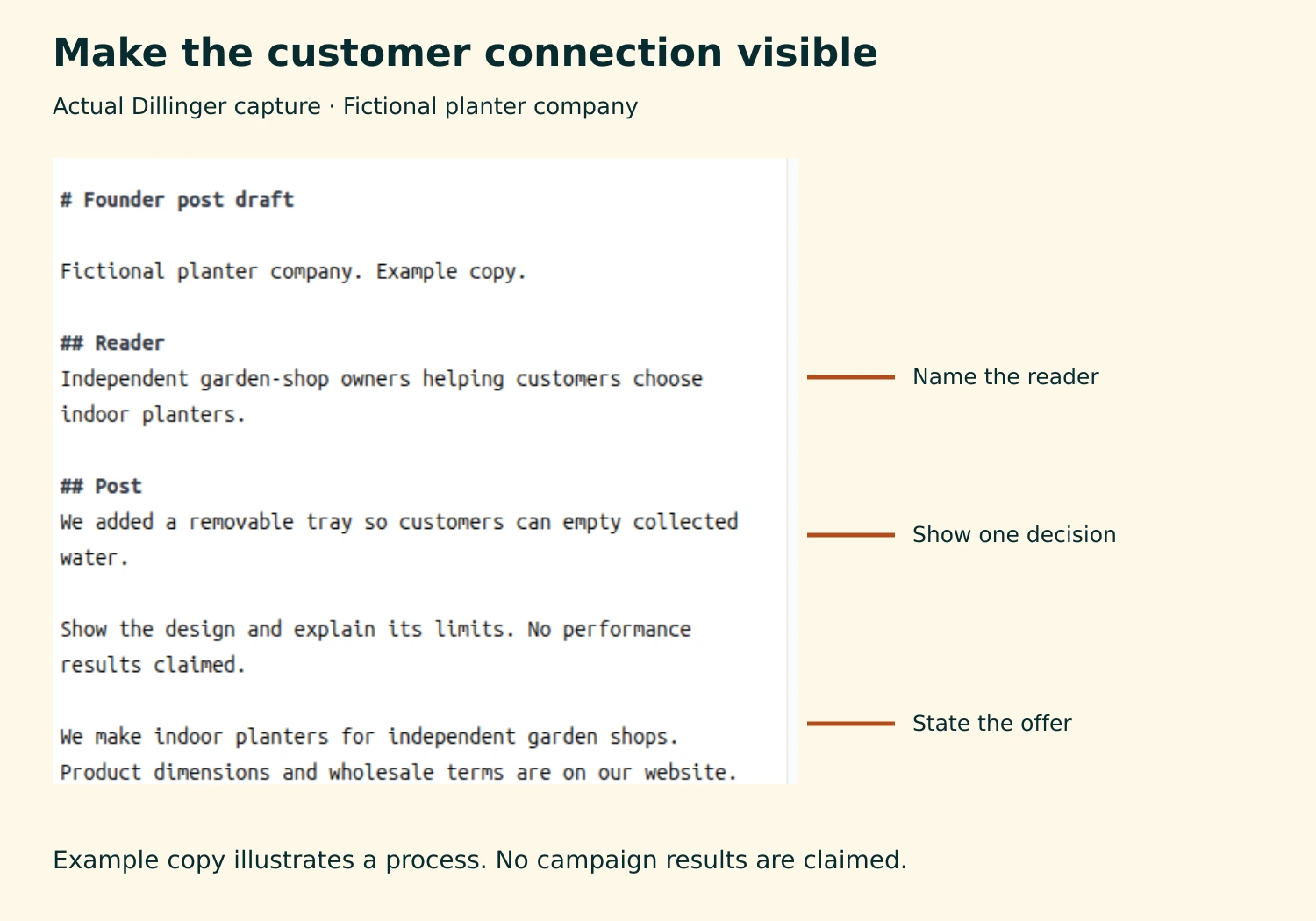
The revision has a boundary: it describes the tray's intended function. It makes no claim about increased sales, fewer complaints, or healthier plants. Evidence for those outcomes would require its own method and records.
For a service business, show a permitted example of the work. A designer could explain a type-size revision and show the relevant menu section. For software, demonstrate an actual task with public, approved, or clearly labeled example data. A product demonstration can establish that a shown action works under the demonstrated conditions. It cannot establish every customer's likely result.
State the company connection and offer plainly
Readers should be able to identify the company and understand what it provides. The founder can say, “We make indoor planters for independent garden shops. Product dimensions and wholesale terms are on our website.” The destination then needs to contain those details and a working contact route.
An educational post can end with a check someone can try. A post answering an active buying question can link to specifications, an example project, availability, or a relevant service page. Match the next step to the subject and keep the explanation complete enough to understand on the platform.
A founder's profile can provide a stable explanation of their role and company while individual posts explore different subjects. A company page can hold product information, team contributions, and announcements. Check that names, current capabilities, and contact routes agree across these destinations. Use the permissions and publishing functions actually available in the account; this process does not depend on a particular profile button or paid feature.
Keep an offer visible when it serves the post. Avoid turning every conversation into a pitch. In a community thread, answer the question and follow the venue's rules. Disclose your connection when linking company material. A public comment gives you no permission to send a private sales message or add someone to an email list.
Adjust the approach to your starting audience
An established audience with a new company: explain the company's customer and problem early. Some followers may share that need, some may refer someone, and some may continue to follow the personal subjects. Observe the response before assuming that the audience and customer base overlap.
A founder whose expertise is the service: show how you reason through a bounded example. Explain what a client receives and the circumstances your service fits. Preserve client permission and distinguish a hypothetical exercise from commissioned work.
A technical product with several decision-makers: choose one reader's task for a post, then connect it to material that gives other participants the context they need. A user may want a workflow demonstration, while an operations lead needs deployment responsibilities and constraints.
A company dependent on one founder's presence: document recurring explanations and invite colleagues to contribute within agreed roles. Keep the company's reference material current so a reader can understand the offer when the founder is away.
This article began with a founder's public question about balancing personal content and company promotion. Replies suggested several posting ratios. The underlying decision applies across these scenarios: choose the customer situation a post can address, then decide how the founder's experience and the company's work help explain it.
Review exposure, understanding, and enquiries separately
Keep a small record of the post URL, intended reader, purpose, evidence shown, response, and next action. Use the platform's definitions for views or impressions and note the period. A visible count describes delivery under that definition; it does not tell you every viewer's needs.
Read specific questions for evidence of understanding. If people ask what the company sells, inspect the company connection and destination. If they understand the offer but ask about suitability, explain the relevant conditions and limits. If the responses come mainly from peers, investigate where intended customers learn and which tasks they discuss.
Record enquiries by the need expressed and whether the offer fits it. Ask how the person found the company when appropriate, while allowing for incomplete recall and several points of contact. A sale following a post does not prove that the post caused it.
Choose the next revision from those observations. An unclear offer needs a clearer explanation and destination. A disputed claim needs evidence or a narrower statement. A mismatch between readers and customers calls for another audience or distribution test. Keep the actual post, response, and resulting decision together so the next test has a recorded starting point.