
A trades marketplace can draw visitors from across the country and still disappoint a homeowner who needs a plumber this week. That homeowner needs someone who serves their postcode, handles their job, and replies in time. A local launch puts enough of the right customers and providers in the same place to deliver on that promise.
A marketplace connects two groups that need each other. The same launch method can help a repair directory, a tutor booking service, or a network of venues that rent space by the hour. Start with a market you can serve reliably. Give that audience a reason to find you. Track what happens after they arrive.
Pick an area and a job
Write your first offer as a sentence a customer can act on. “Request a quote for a small plumbing repair in North Ward and hear from a provider by the next business day” gives the team a job type, a boundary, and a response window to test. Use a response promise in public only once your trial gives you evidence you can keep it.
Draw the boundary around how people provide the service. A bicycle repair pickup might work within a few adjacent postcodes. A venue marketplace might cover a transit corridor. For online tutoring, the equivalent of a neighborhood may be a single exam and a set of after-school hours. Demand and provider availability need to overlap at the time the customer acts.
Compare candidate areas using evidence you can collect this week:
- Customer need. Ask local partners what people request repeatedly. Ask customers how they found help last time, how long it took, and where they got stuck.
- Provider capacity. Confirm the jobs, locations, and times providers will accept. Agree on how they will hear about requests and how soon they can reply.
- Reach. Identify a channel that already speaks to those customers, such as a neighborhood newsletter, a hardware shop, or a venue association. Ask what they allow and what information would benefit their readers.
Airbnb's first guests came to San Francisco for a design conference and stayed with the founders. That is a historical example of a clear occasion, a specific place, and hosts who were ready. DoorDash's 2020 filing describes a local feedback loop in which more nearby merchants improve selection for customers. Those cases illustrate two ways location can shape an offer. Your first market depends on where your own customers and providers overlap.
Airbnb’s first guest staysAirbnb describes the conference and home that brought the first guests and hosts together.↗ DoorDash’s 2020 registration statementThe Local Network Effects section describes how the company connected local selection with customer demand.↗Recruit for the requests you plan to attract
Before inviting the public, walk a few test requests through the whole process. Check the form, provider notification, reply, and what the customer sees if nobody is available. Use a test request with providers who have agreed to take part. In a small pilot you can make introductions by hand and record where the process slows.
Build your provider list around coverage. Four electricians who only take rewiring projects leave a gap if the offer promises small repairs. Two tutors who can cover the same exam at different times may cover more requests than a directory full of profiles with the same hours. Track active capacity and eligibility by job and time window. For trust claims, state what you checked. For example, “We confirmed the business name and service area” sets a clearer expectation than a vague badge.
Then market the offer through a channel that reaches the people it can serve. A hardware shop might share a card with landlords who ask about small repairs. A neighborhood newsletter might publish a short guide to describing a leak and link to the request form. A venue association might share an example budget with local organizers who need a weekday space. Give each partner a message and destination that match the promise. Track the partner or channel that sent each request where you can.
Read the launch by area
Track visits from the intended audience, eligible requests, requests that received a qualifying reply in time, and confirmed bookings or successful introductions. Define those stages in advance. A reply qualifies when the provider serves the location, can do the job, and can take it in the needed window. Count each request at most once in each stage. Keep requests that are still inside the reply window in a separate pending count until you can assess them.
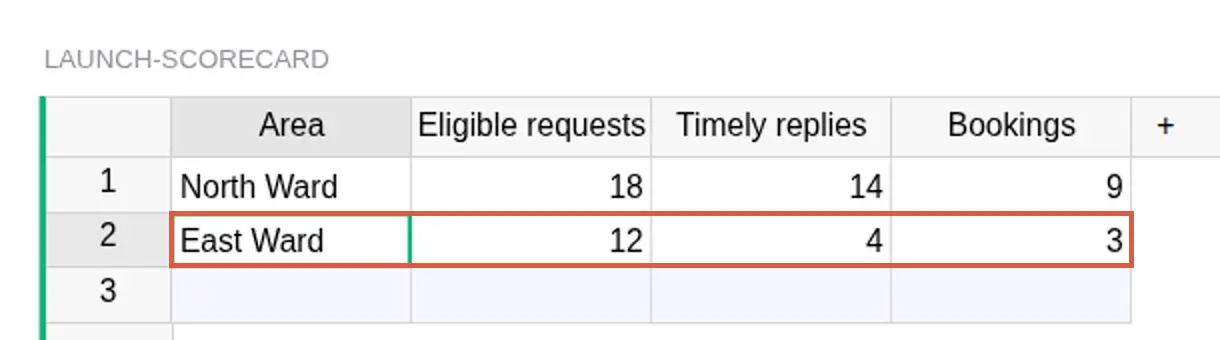
Suppose North Ward had 18 eligible requests with completed reply windows. Fourteen got a qualifying reply in time and nine led to bookings. East Ward had 12 requests, four timely replies, and three bookings. The timely reply rate is 14 out of 18 in North Ward and four out of 12 in East Ward. A combined rate of 18 out of 30 would hide the difference. Follow up on the eight East Ward requests that missed the window. If several needed Saturday appointments, find out whether providers were unavailable on Saturdays or the request never reached them.
Read the breakdown before changing the campaign:
- Few eligible requests, quick replies. Check whether local people saw the offer and understood it. Try another partner or test a clearer description of the job you handle. With a small count, keep checking capacity as demand grows.
- Many eligible requests, slow replies. Review the job types, hours, and streets that went uncovered. Arrange more provider coverage or narrow the offer before sending more people there.
- Quick replies, few bookings. Follow up on a few cases with permission. A provider may reply in time and still quote an unsuitable price or date. Check what the page led people to expect.
- Cases outside your coverage. Count them separately. A cluster of similar requests in an adjacent area can help you decide where to recruit next.
Visits can tell you whether a channel reached people. Reply and booking figures show what happened when they tried the service. Keep the counts alongside any percentages, especially early on. They show how much evidence you have for your next decision.
Decide where to expand
Choose an expansion rule before the pilot. For example, you might want at least eight out of ten eligible requests to get a qualifying reply within a business day, with enough requests across several ordinary weeks to include both quiet and busy periods. That target is a fictional example. Set your own target around what customers need, what providers can sustain, and how costly a failed match is.
Once the first area is meeting its promise, pick the next area where you have evidence of demand and can recruit capacity. Line up providers, repeat the dry run, and measure the new area's results separately. Keep checking the first area while the second ramps up. Shared providers can become busier in both places.
If you already get visits from across the country, let people check coverage before they fill out a request. Show the areas you serve today. Give people outside them the option to ask for an update. Use those requests to plan where to open next, and turn on promotion when that area can handle the demand.