
A free service sample gives someone a small experience of your work: a short review, a guided exercise, or a session that produces a defined result. Plan the task, the participant’s contribution, the time you will both spend, and the point where the sample ends. Then review what people completed and what they understood about your service.
This can help a person discover how you think before deciding whether to hire you. It also costs time on both sides. An offer of several months of free support leaves many decisions open: what happens first, what the participant must prepare, and what either person can expect at the end.
The process below is BrandTofu’s editorial framework for introductory service experiences. The examples are fictional. It is a planning method, with no promised attendance, sales, or conversion result. Sources and the demonstrated editor were checked on October 29, 2026.
Choose the decision the sample should help someone make
Start with the person and a task they already want to complete. Then write what they should be able to assess after the sample. A musician might need to choose a promotional action for a release. A restaurant owner might need to see how a menu designer makes one section easier to scan. An operations lead might want to understand how a research consultant turns interview notes into a question to investigate.
Each example can introduce expertise through an experience. The musician sees the adviser’s reasoning. The restaurant owner can compare a layout with its stated purpose. The operations lead can inspect how observations support an interpretation.
Choose a result small enough to deliver within the sample. “Choose one promotional action and write down why it fits the intended audience” gives the music session a finish. “Develop your career” requires a much longer relationship and many decisions beyond an introductory session.
IDEO.org’s Build & Run Prototypes method recommends making an idea tangible, trying it with the people it is intended for, and using their feedback to revise it. Applying that principle to a service sample means demonstrating one part of the experience and learning from it. The method does not establish that a free sample will produce paying clients.
Decide what you can offer repeatedly
Set a limit on your own time before inviting people. Include preparation, delivery, written follow-up, scheduling, and review. A thirty-minute session may involve another half hour of work around it. Those are planning estimates to check against your actual time.
Choose a format that fits the task and the time available:
- A public demonstration lets people see your process with your own example. It suits an audience that is still learning what the service does. Record what questions remain after the demonstration.
- A short individual session lets someone bring a relevant problem and work through one part of it with you. State what they need to prepare and the result you can finish together.
- A small group clinic lets several people learn from related examples. Explain which work can be discussed publicly and provide a way to ask a question privately when appropriate.
- A fixed project sample delivers a limited piece of work, such as a review of one page. Define the input, output, revision allowance, and stopping point before starting.
For work that takes substantial production time, a paid introductory project may fit your capacity. If accessibility is a goal, you can also maintain a free example, worksheet, or public lesson. State the terms of each option clearly so people can choose.
Write the invitation as a small working agreement
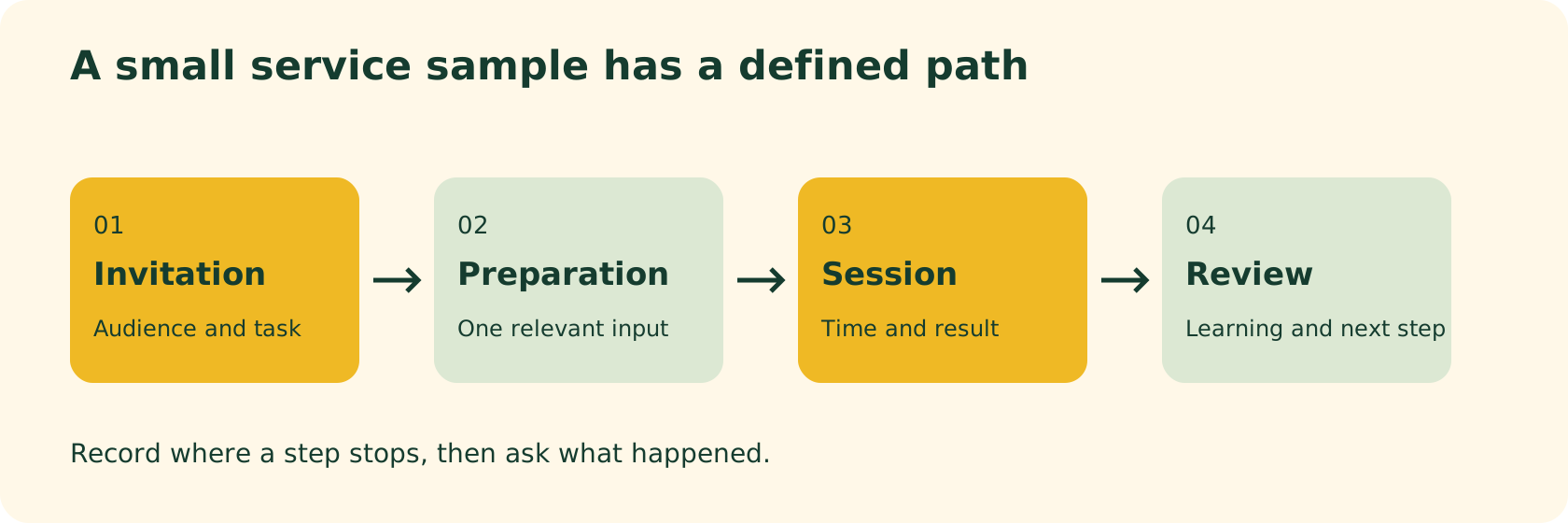
The invitation should tell a person whether the sample fits their situation and whether they can participate. Include the audience, task, preparation, time, result, and next step. Add the practical details that affect attendance: location or joining route, time zone, access needs, and how to change plans.
GOV.UK’s guide to planning a round of user research starts from explicit learning objectives and includes participant needs, session logistics, a practice run, and time to analyse findings. It concerns research sessions. We use those planning principles here to make an introductory service experience easier to understand and review.
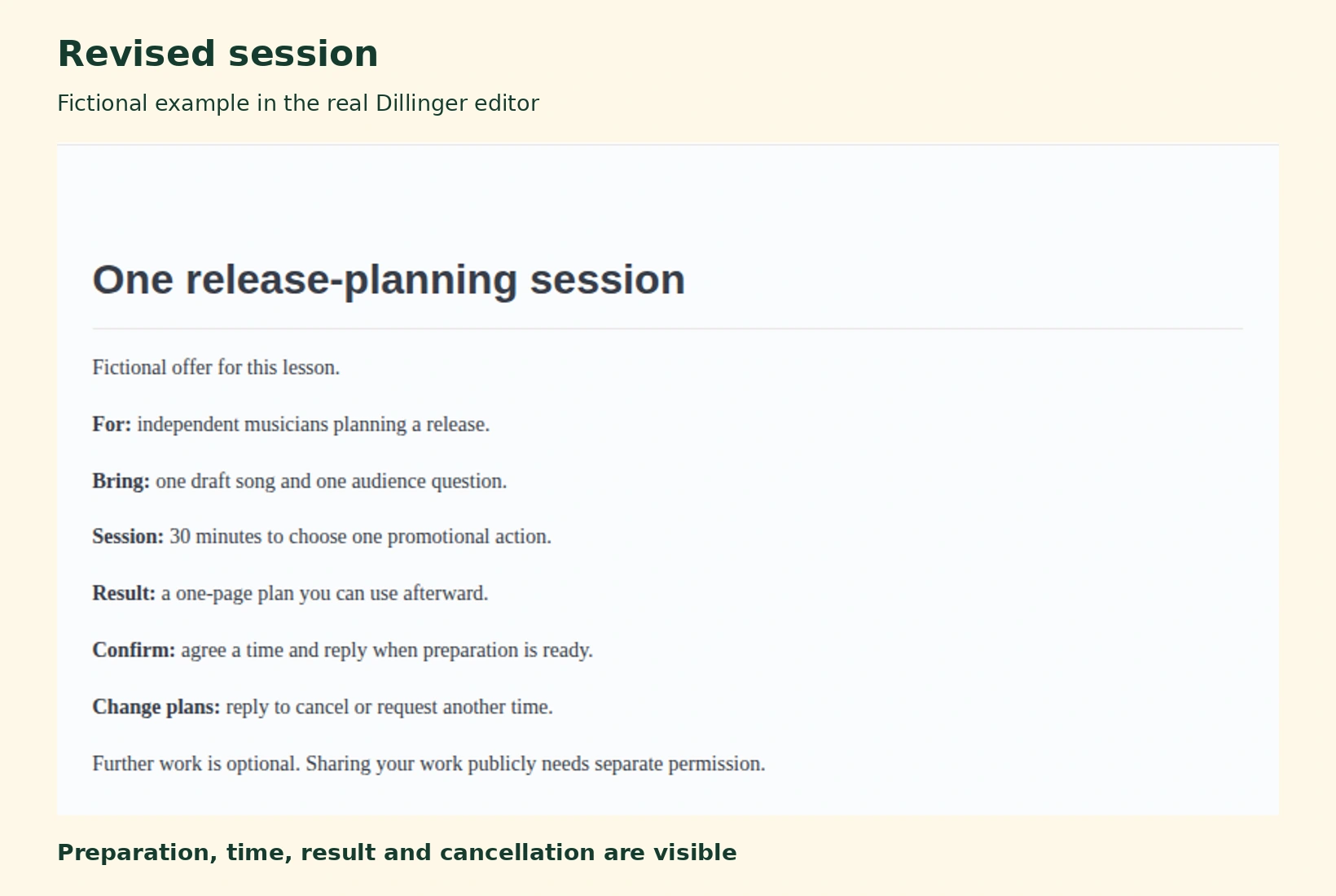
Ask only for preparation the session actually needs. For the fictional music example, one draft song and one audience question are enough to begin the stated task. Requesting a complete business plan would add work that the session does not use.
Offer a practical alternative when the input is difficult to provide. A participant could describe their draft by phone if uploading a file is a barrier. Check whether the alternative still supports the task. Keep the requested information proportionate to what you will do with it.
Worked example: revise an open-ended offer
This article began with a service founder’s question about free artist-development work. People expressed interest, joined briefly, and then disappeared. The question was how to keep services accessible while finding people ready to take part.
That account does not tell us why each person stopped. It does suggest a planning question: can a new participant understand and complete the first step before agreeing to a longer relationship?
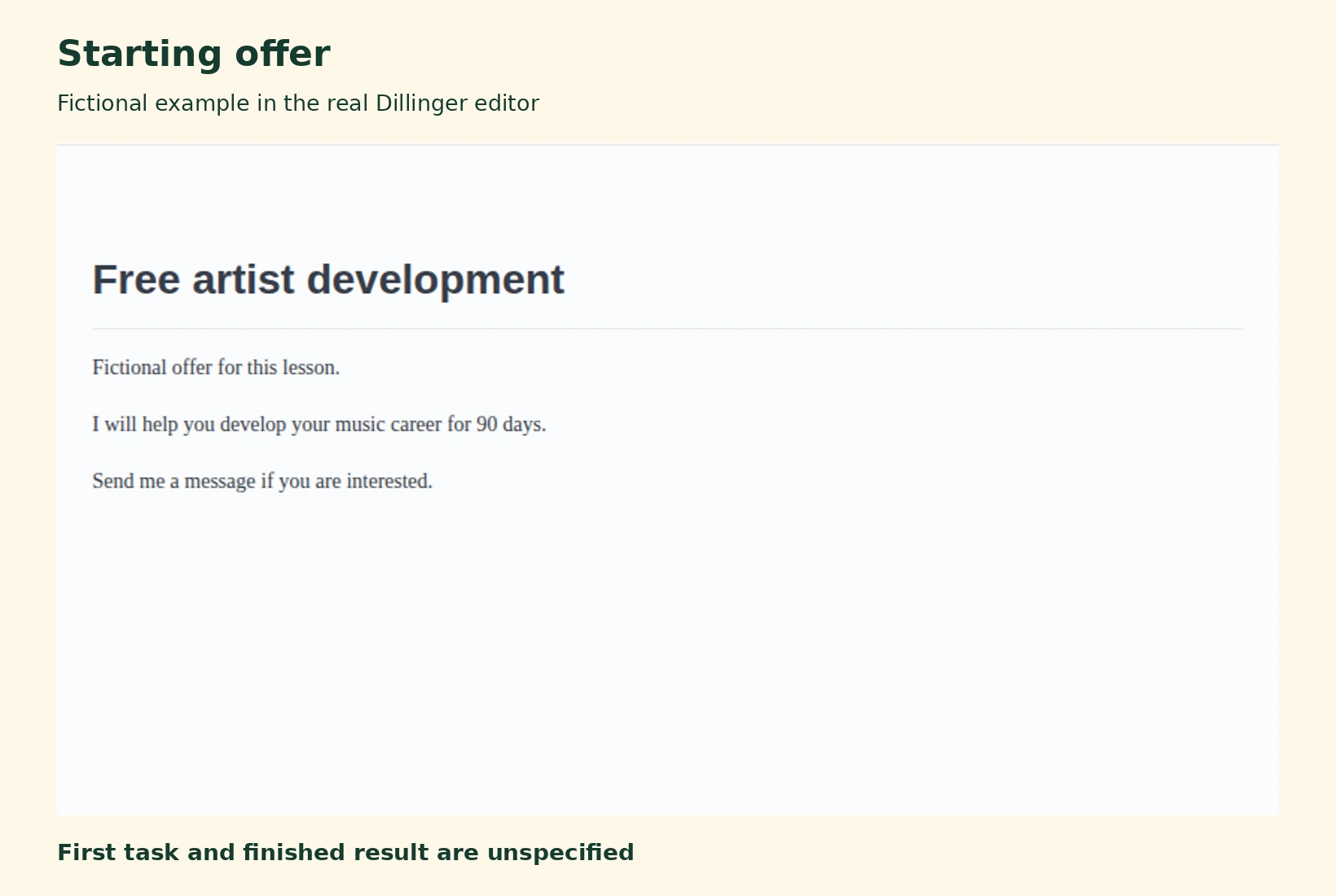
Our fictional starting offer says: “I will help you develop your music career for 90 days. Send me a message if you are interested.” It leaves the task, preparation, and stopping point open.
We revise it in Dillinger, a browser-based Markdown editor. Markdown is plain text with formatting marks for headings and emphasis. The basic editing, file import, and preview used here are available with no signup or payment. We connected no cloud account. Any text editor can support this exercise; the editor displays the brief and does not evaluate the offer.
The revised offer is a single release-planning session for independent musicians. The participant brings one draft song and one audience question. The session lasts thirty minutes, and its result is a one-page plan for one promotional action. The participant confirms a time and replies when their preparation is ready. They can cancel or request another time.
The result is a clearer offer to test. We have not run this session with customers or measured an attendance change. Before inviting people, rehearse it with a colleague and check that the task and written result fit the time. If they do not fit, reduce the scope or revise the time estimate.
The same approach works for other services. A menu designer could review one section and explain two layout choices. A researcher could guide a team through separating an observation from an assumption using fictional notes. A communications adviser could help a founder explain one announcement to a named audience. Each sample needs its own preparation and finish line.
Make participation and continuation explicit
Confirm the agreed task and time before the session. Provide a straightforward way to cancel. If someone has not supplied the required input, ask whether they need a different format or time before producing work that depends on it.
At the session’s end, give the participant the promised result and explain what happens next. They might use the plan themselves, return to a public resource, request a paid proposal, or stop. A free sample can end with the completed task.
Keep portfolio permission separate from participation. If you want to publish someone’s work, feedback, image, or results, explain the proposed use and ask for permission. Someone can benefit from the sample while declining public credit or a testimonial.
For sessions that also collect user research, GOV.UK’s informed-consent guidance explains how to tell participants the purpose, activities, information collected, and intended use. Its research guidance also preserves voluntary participation and withdrawal. A service invitation should distinguish the work being offered from any research or publicity request attached to it.
Investigate drop-off before changing the price
A missing reply tells you that a step did not happen. It does not tell you whether the person lost interest, misunderstood the task, lacked time, encountered an access problem, or faced another constraint.
The COM-B model in Michie, van Stralen and West’s original paper describes behaviour through interacting capability, opportunity, and motivation. Capability concerns the ability to act. Opportunity concerns the circumstances that make the action possible. Motivation concerns the processes that direct action. This is a general behaviour framework, not evidence about the people in the source thread or a forecast for service samples.
Use it to generate questions you can check. Could the participant prepare the material? Did the time and joining route work? Did the task still address a need they wanted to pursue? Ask a short, neutral question about where they stopped. Record their answer in their own terms, and accept that some people will not reply.
Changing the price also changes who can join and what they expect. A paid sample may fit the work and your capacity. Payment alone cannot establish why earlier participants disappeared, and free participation cannot establish willingness to buy. Evaluate each offer against its stated purpose.
Keep a record of completed steps and decisions
For one small round, record the invitation version, how people found it, the task, the agreed input, the session status, the result, and your time. Keep counts for each step separate. A fictional record might show twelve invitations, six confirmations, four attended sessions, and three completed follow-up actions. These are example counts, not a benchmark or a result from this workflow.
Add questions that reveal what people learned: can they explain the next action, why it fits their audience, and what help they would need to carry it out? Keep enquiries about further work in a separate field. A completed learning task and a request for paid help answer different questions.
Choose a revision from the observed problem. If preparation repeatedly takes too long, inspect the input request. If participants attend but leave with an unfinished plan, inspect the task and time. If they finish but misunderstand the service, revise the explanation and next step. Record the change beside the evidence that prompted it before running another round.