
A small business-to-business (B2B) roundtable brings people from different businesses together to discuss a shared work problem. The host provides a question, a suitable group, and a way for everyone to contribute. Participants bring experience they can compare and apply.
For a business trying to become known among a specific audience, that conversation can introduce its expertise and reveal questions for future educational content. Hosting also takes time: finding guests, arranging access, preparing the discussion, and following up. A recurring event needs a plan for both the guest experience and the work behind it.
Start with a pilot session that you can review before scheduling more. Check the topic with prospective guests, assign the hosting tasks, and estimate the full workload before committing to a series. The example businesses, hours, and event counts are fictional planning figures. Sources and the demonstrated spreadsheet were checked on November 2, 2026.
Choose a problem that peers can discuss
Write the guest's working question before choosing the event name. “Operations leaders' lunch” describes a format and an audience. “How do small operations teams keep handovers moving when a colleague is away?” gives someone a reason to bring an example.
A roundtable suits a problem with several approaches and enough shared context for participants to understand each other. A software consultancy might gather operations managers around handover practices. A packaging supplier might host food producers discussing how they prepare packaging briefs. An accountant could bring independent shop owners together to discuss the records they need before meeting their bookkeeper. Specialist claims still need review by the relevant professional.
Ask a few prospective participants which part of the proposed question they are currently handling. Ask what would make the discussion worth setting aside time for, which peers they would like to learn from, and what they could comfortably share. Treat those conversations as topic checks. A polite expression of interest does not establish that somebody will attend.
Cvent's roundtable guidance connects a focused topic, a relevant mix of participants, moderation, and a follow-up summary. It is an event provider's practical guidance. It does not establish an attendance rate or a return you can expect from your own session.
If participants mainly need an explanation from an expert, a lesson or demonstration may fit. If you need to understand a person's private experience in depth, an individual research conversation may fit. Participants should be able to build on each other's experience.
Define who belongs at the table
Choose participants by their relationship to the problem. A screening question for the handover discussion is: “Have you recently been responsible for coordinating work across an absence?” A job title can help locate people, but it does not establish that experience.
Write down the common ground and the differences you want represented. For example, participants might all manage small operations teams, with some working in offices and others across locations. Too little common ground makes every contribution require a long explanation. Large differences in seniority or commercial interests may make people less comfortable speaking.
The Government Digital Service's small-group research guidance describes how participants can learn from each other, while dominant speakers and differences in seniority can affect what gets said. Its purpose is user research; the participation issues also help a marketing host plan a peer discussion. A marketing roundtable is not automatically a research study or a representative sample of a market.
For an initial pilot, choose a group small enough for each person to speak during the available time. Work backward from the agenda: introductions, examples, comparison, and a closing decision all need space. The right size depends on the topic and format. Decide the smallest group that can support the discussion before inviting people so you can decide whether to proceed, postpone, or offer a different conversation.
Give each invitation a specific reason
An invitation should tell someone why the topic fits their work, who the discussion is for, how it will run, and what commitment it asks of them. State the date, location or joining method, length, cost if any, and preparation. Explain the host's commercial role and whether a product demonstration or sales discussion is included.
For the fictional operations session, the invitation could say:
We are gathering a small group of operations managers to compare how they handle work handovers during absences. Bring a situation you can discuss in general terms. The session lasts 60 minutes, with time for everyone to contribute. We run a consultancy in this area and will facilitate the discussion. There is no product presentation. We will send participants an unattributed summary of the approaches discussed.
Use an existing, appropriate relationship or a permitted community route to invite people. A customer or partner may know peers who share the problem. Agree what the co-host contributes, which invitations they will send, and who receives responses. An introduction to a relevant audience can help; it still leaves somebody responsible for confirming the guest's interest and needs.
Keep a simple response record: invited, interested, confirmed, declined, or waiting for a reply. Record the reason for declining when the person volunteers it. Timing, topic, travel, access, and unclear expectations suggest different changes. Avoid treating every decline as evidence that you need a larger invitation list.
Make the hosting workload visible
List the work before choosing a monthly or quarterly schedule. Include topic checks, invitations and replies, venue or joining arrangements, facilitation, participant materials, and the summary. Assign an owner to each task. A co-host's role needs an agreed deliverable and time commitment.
Our fictional plan assigns two hours to topic validation, three to invitations, two to logistics, an hour to facilitation, and two to a participant summary. That is ten team-hours per event. The estimate excludes travel, catering costs, and any extra preparation a particular subject needs.
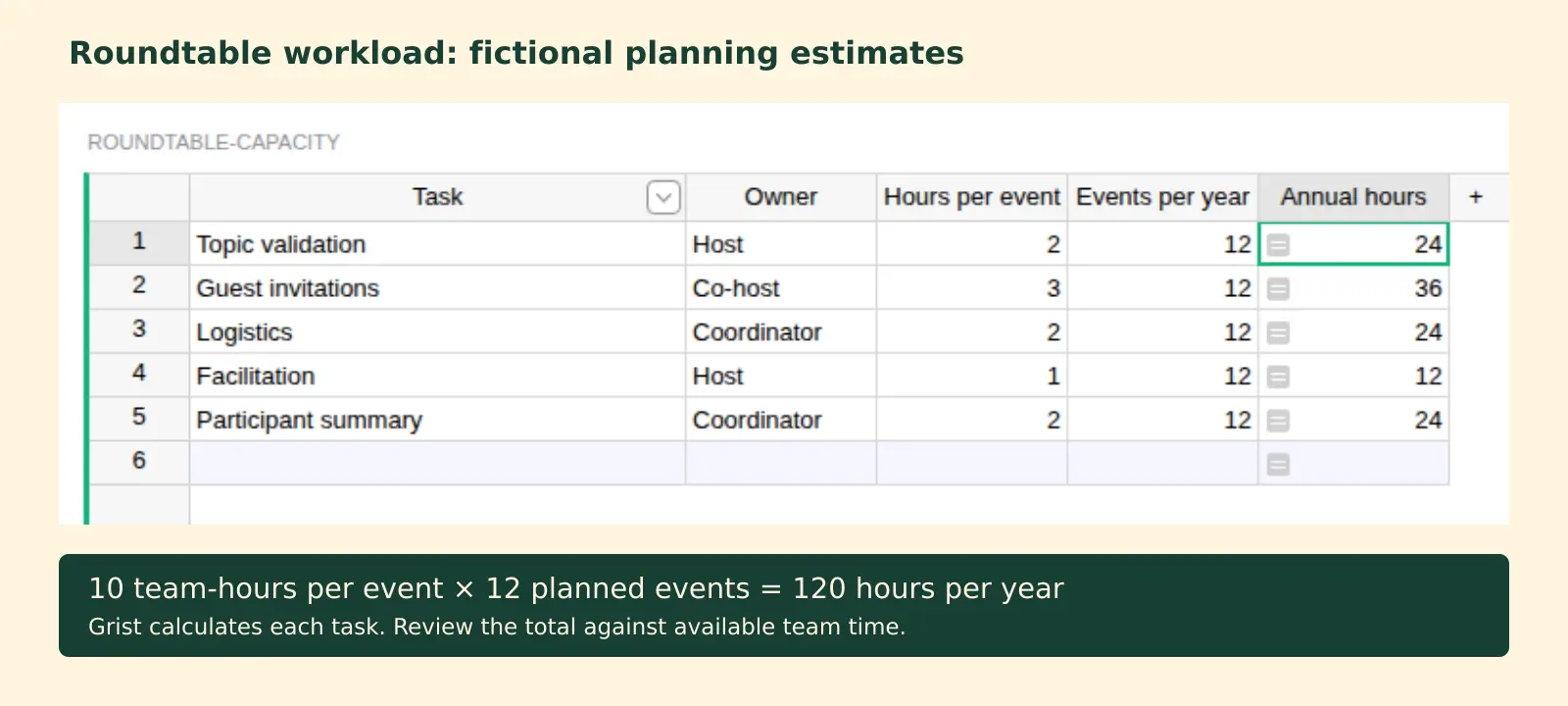
The example uses Grist's spreadsheet editor. Its anonymous document mode allowed us to import and edit this small example with no signup or payment on the check date. The demonstration makes no claim about paid-plan limits or long-term document storage. Save an exported copy if you use an unsaved example document.
We made Annual hours a formula column using $Hours_per_event * $Events_per_year. Grist applies the calculation to each task. Its data-entry documentation explains cell editing, keyboard navigation, and pasting ranges; its formula introduction explains references to the current record's fields.
In the worked sequence, changing the planned event count from 12 to 4 changes the annual task hours. Ten hours per event across twelve events totals 120 hours. Across four events, the same task estimates total 40 hours. These are arithmetic scenarios. They do not show that quarterly events perform better, or that your events will take ten hours.
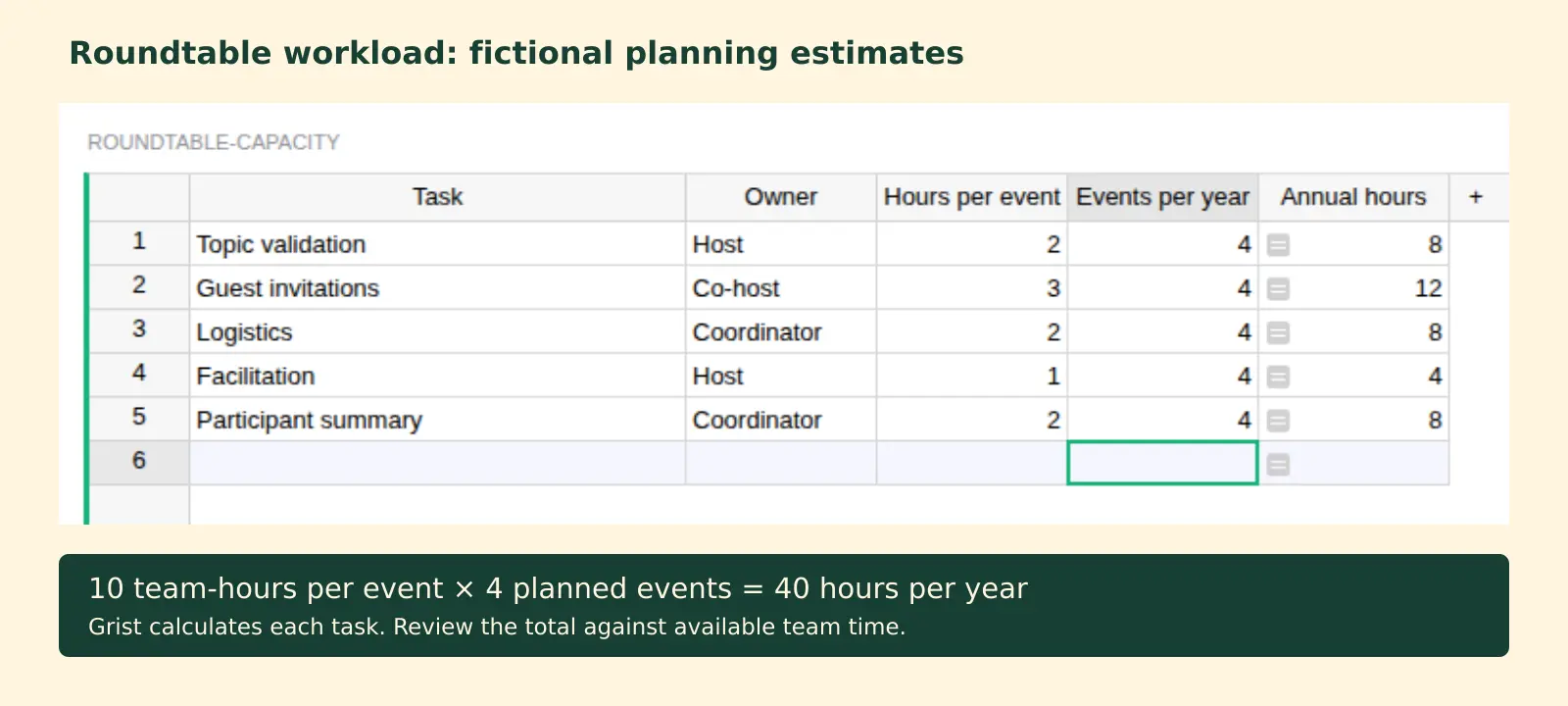
After the pilot, replace estimates with the time actually spent. Review where work expanded: repeated invitations, unclear ownership, changing logistics, or a summary that took longer than planned. Choose the next date using both guest demand and available capacity. A monthly slot is a commitment to repeat all of that work.
Plan a conversation people can participate in
Give the facilitator a short brief containing the question, participants' shared context, agenda, prompts, and agreed boundaries. The facilitator's job includes inviting quieter voices, limiting lengthy contributions, and connecting examples back to the question.
A fictional 60-minute agenda might allow five minutes for the purpose and participation rules, ten for introductions, twenty for recent examples, fifteen for comparing approaches, and ten for each person to name a next step. Adjust the time when the topic or group needs it. Ask for examples people can discuss safely; confidential customer or employee details do not belong in the shared notes.
Eventbrite's roundtable planning guide recommends a facilitator brief and an agenda covering the topic, purpose, questions, timing, and ground rules. Use those fields to prepare the session. The schedule above is an illustrative allocation, not a performance benchmark.
Choose recording and attribution rules before recruitment. If you hold the session under the Chatham House Rule, participants may use information from it while protecting speakers' and participants' identities and affiliations. The organization's current guidance also says recordings, photographs in the room, and AI notetakers are not allowed. Explain and apply the actual rule if you use its name.
For a public, attributed discussion, tell participants how their contributions, images, and recordings will be used and obtain the appropriate permissions. If the session also serves a research purpose, explain that purpose. GDS's informed-consent guidance describes telling research participants what is collected, how it will be used, and whether observation or recording is involved. Check the requirements relevant to your own activity and location.
Review the pilot before committing to a series
Keep the guest experience, marketing observations, and operating cost visible in the same review. Record who confirmed and attended, whether participants could contribute, the questions that recurred, any follow-up they requested, and the team's time and spending.
Ask participants what they can apply and what remained unanswered. Their answers may suggest a follow-up lesson, an improved invitation, or a different mix of guests. Obtain permission before turning a person's contribution into an attributed story. An unattributed summary can still identify somebody through specific circumstances, so review its details before sharing it.
This article began with a founder's LinkedIn question about event workload and audience recruitment. His own lunches felt promising, while monthly hosting burdened the team and finding suitable guests became harder. A pilot review helps separate those problems: the topic may need revision, invitations may need a clearer audience fit, or the cadence may exceed the team's capacity.
Attendance describes participation. A requested follow-up describes a person's next action. A later sale needs its own record and context; its timing alone does not establish that the event caused it. Keep those observations separate when deciding how the event contributes to the wider marketing plan.
Choose the next commitment from the record. Repeat when the guest question remains relevant and the work fits the team. Revise the topic, roles, invitation, or format when the evidence points there. Keep an owner and a review date beside the next event so the series has a decision point after the pilot.