
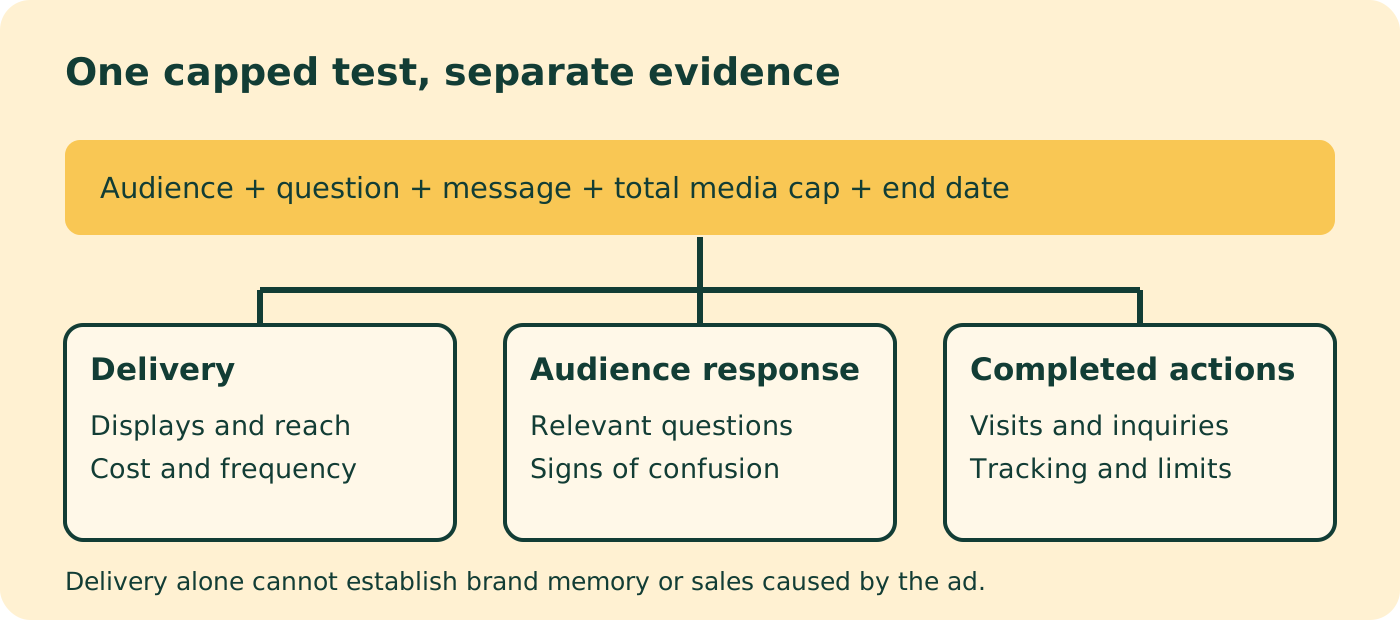
A small paid awareness test buys a defined amount of exposure to an intended audience and gives you evidence for the next decision. Write the question, spending cap, dates, message, and review criteria before you publish the ad. Then report delivery, audience response, and business actions separately.
A creator recently asked on Facebook how much people spend each week boosting posts, and whether that spending produces results. A weekly average from another account leaves several gaps: their audience, goal, location, creative, and definition of a result may differ from yours. The planning process below helps creators, local businesses, and small marketing teams decide what a first test can establish.
This is BrandTofu's editorial framework. The numerical example is invented for teaching. Platform documentation was checked on October 21, 2026; available controls depend on the account and campaign.
Write the decision the test should inform
Choose one question you can investigate with the money and time available. “Does advertising work?” covers too much. A pottery studio might ask whether a short introduction to its beginner class reaches nearby adults and prompts questions about attending. An independent creator might ask whether a particular explainer attracts people who return for another episode. A software team might test whether a short demonstration brings relevant visitors to a public tutorial.
Define the audience in language you can check. “Adults near the studio who are considering a first pottery class” gives the team a reason to choose a location, example, and message. A platform's targeting settings approximate that audience. They cannot establish that every person reached has the intended need.
Write the next step you want to make possible. A viewer might read a class description, watch a second lesson, or ask about the materials. Give the ad a complete small explanation so a person can understand it in the feed. Check that the destination answers the question raised by the ad.
For our fictional studio, the message is: beginners can make a first bowl in a guided introductory class. The video shows the starting material, one teaching moment, and the finished example. The linked page explains duration, price, location, and what participants bring. Those details let an interested viewer assess the class.
Match the campaign goal to the question
Meta's current awareness objective documentation distinguishes performance goals for reach, impressions, recall lift, and video viewing. Those choices ask the delivery system to pursue different outcomes. Check the actual goal offered by the setup you use, including a simplified boost flow.
If the question concerns exposure to a relevant audience, delivery reporting can help. If your decision requires registrations or purchases, design the destination and measurement around that action and inspect the objectives available for it. A large impression count alone cannot answer a registration question.
A boosted existing post can be a manageable starting asset when it already teaches the intended lesson. Before paying, inspect its message, audience, destination, objective, dates, and budget controls. An organic post that attracts peers may still miss prospective customers. Existing likes are a clue to inspect, with limited evidence about a new paid audience.
Set a total cap you can afford to learn from
Choose the amount the business can spend on this question even if the test produces no further action. Include the work needed to make the asset, set it up, check it, and answer responses in a separate production estimate. A $60 media test that takes a full working day has a different total cost from a $60 test using an approved asset.
Set a fixed end date and record the currency and budget scope. A campaign budget and several separate ad-set budgets can have different totals. Read the confirmation screen before publishing.
Meta describes a lifetime budget as spending over the campaign or ad set's full run. Its daily budget guidance describes a daily target with spending flexibility. A daily number therefore needs to be understood alongside its applicable limits, schedule, and any sharing settings. Use the total-budget controls available to your setup when your plan depends on a fixed total.
Our fictional studio chooses a seven-day run and a $60 total media cap. That amount illustrates the record; it is no recommendation about the money your account needs. If the platform's minimums or expected delivery cannot support the question within your cap, revise the test or keep learning through audience conversations and organic posts.
Keep the first test narrow enough to interpret. Spreading a small cap across many audiences and creative variants can leave each with little evidence. Record one audience definition and one clear message. If you compare variants, define the changed element and the comparison in advance.
Calculate what delivery cost
Impressions count displays under the platform's definition. Reach estimates distinct people or accounts reached, depending on the reporting system. Frequency describes repeated exposure on average. Keep the date range, reporting level, and metric definition with every export.
LinkedIn's delivery metric definitions explain reach as unique member accounts with an impression and average frequency as impressions per reached account. LinkedIn also says these delivery figures are modeled and may arrive after a delay. Read each platform's own definitions before comparing reports, and allow reporting to settle.
For the demonstration, we used EtherCalc, a browser spreadsheet that supports editing and formulas with no account. We checked its public editor on October 21, 2026. The example contains invented data; it contains no customer or advertising-account information. You can use a spreadsheet you already have.
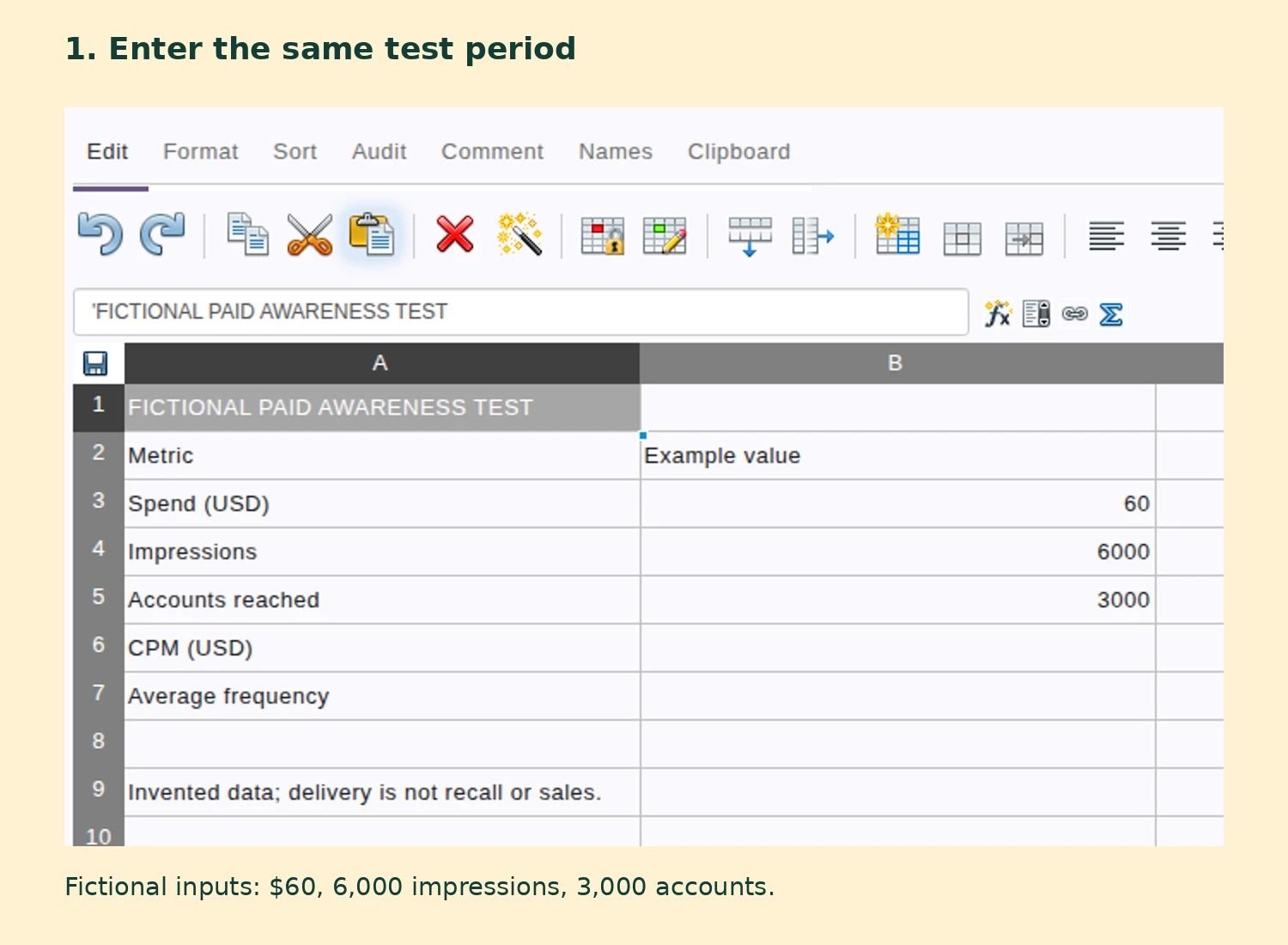
The example records $60 spent, 6,000 impressions, and 3,000 accounts reached. Calculate:
- Cost per thousand impressions, commonly called CPM: spend divided by impressions, multiplied by 1,000. Here, $60 / 6,000 × 1,000 = $10.
- Average frequency: impressions divided by reach. Here, 6,000 / 3,000 = 2.
With spend in B3, impressions in B4, and reach in B5, enter =B3/B4*1000 for CPM and =B4/B5 for average frequency. Check that the denominators contain a positive number. Our real spreadsheet demonstration calculates 10 and 2 from those example inputs.
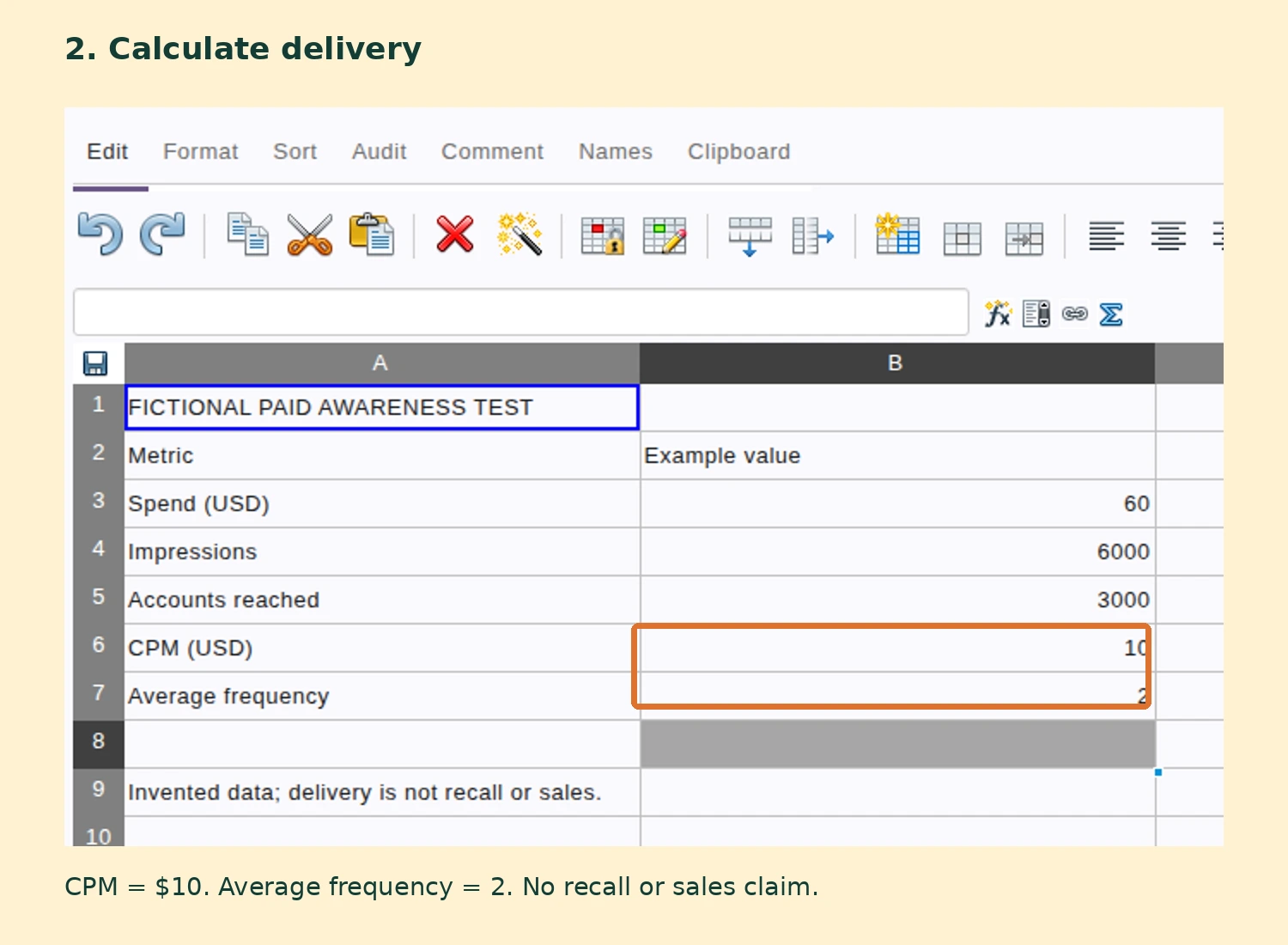
The $10 CPM describes the cost of displays. It provides no market benchmark. The frequency of two is an average: some accounts may have received one display and others several. Avoid adding reach across overlapping ads and treating the sum as distinct people. Use the reporting level that matches the whole test.
Record what people understood and did
Keep a response log beside the delivery figures. Note questions that reveal audience fit or confusion. For the pottery class, “Can I attend as a complete beginner?” may reveal missing copy; “Can I bring my own clay?” may suggest the page needs clearer preparation instructions. Remove personal details when sharing the log.
Record completed next steps separately: tutorial visits, inquiries, registrations, or other actions defined in the plan. Keep the measurement method beside them. A tagged link can identify some recorded visits from that link. It will miss some journeys and does not establish that the ad created every recorded action. A person may have seen an earlier post or heard about the studio from a friend.
Brand memory requires evidence about memory. You could ask a consistent audience sample what businesses they recall for a specific need, keeping the question and recruitment method stable. A small convenience sample offers clues. It cannot establish population-wide lift. A causal lift claim requires a suitable comparison between exposed and unexposed groups and enough data to interpret it. Google’s Brand Lift documentation explains this distinction through surveys of people who saw ads and a comparison group who did not. That measurement product has its own eligibility requirements; the worksheet here does not run a lift study.
For a small first test, an honest report might say: “We spent $60. The platform reported 6,000 impressions and estimated reach of 3,000 accounts. We received four relevant class questions. We have not measured brand recall or incremental registrations.” The four questions in this sentence are hypothetical too; the example demonstrates reporting language.
Choose the next action at the review date
Compare the evidence with the original question before increasing spending. Use the pattern you observed to choose a revision:
- If the people responding seem outside the intended audience, inspect targeting, placements, and the message that attracted them.
- If relevant viewers ask the same basic question, make that answer visible in the ad or destination.
- If recorded visits arrive but the next step fails, check the page on a phone, the information promised, and the action itself.
- If frequency rises while estimated reach barely grows, inspect audience size and repeated delivery before adding budget.
- If the evidence is too thin, state that limitation. A second bounded test is a new decision with its own cap.
Keep the first plan and the final report together. Write the changed element for the next run, such as “show the class duration in the video” or “test one adjacent local area.” That gives the next result a context you can inspect.