
Business networking is the work of meeting people, learning about their work, and developing professional relationships over time. For a small business, an event can introduce the business to people who may later become customers, collaborators, or sources of advice. Plan the conversation you want to have, the time you can spend, and how you will follow through.
A first event can feel difficult because several tasks arrive together: entering a room, explaining your work, listening, and deciding how to stay in touch. Prepare those tasks separately. A short introduction and a question tied to the event give you somewhere to begin.
The process below is BrandTofu's editorial recommendation. Its examples are fictional. The cited guidance was checked on October 27, 2026.
Give the visit a learning goal
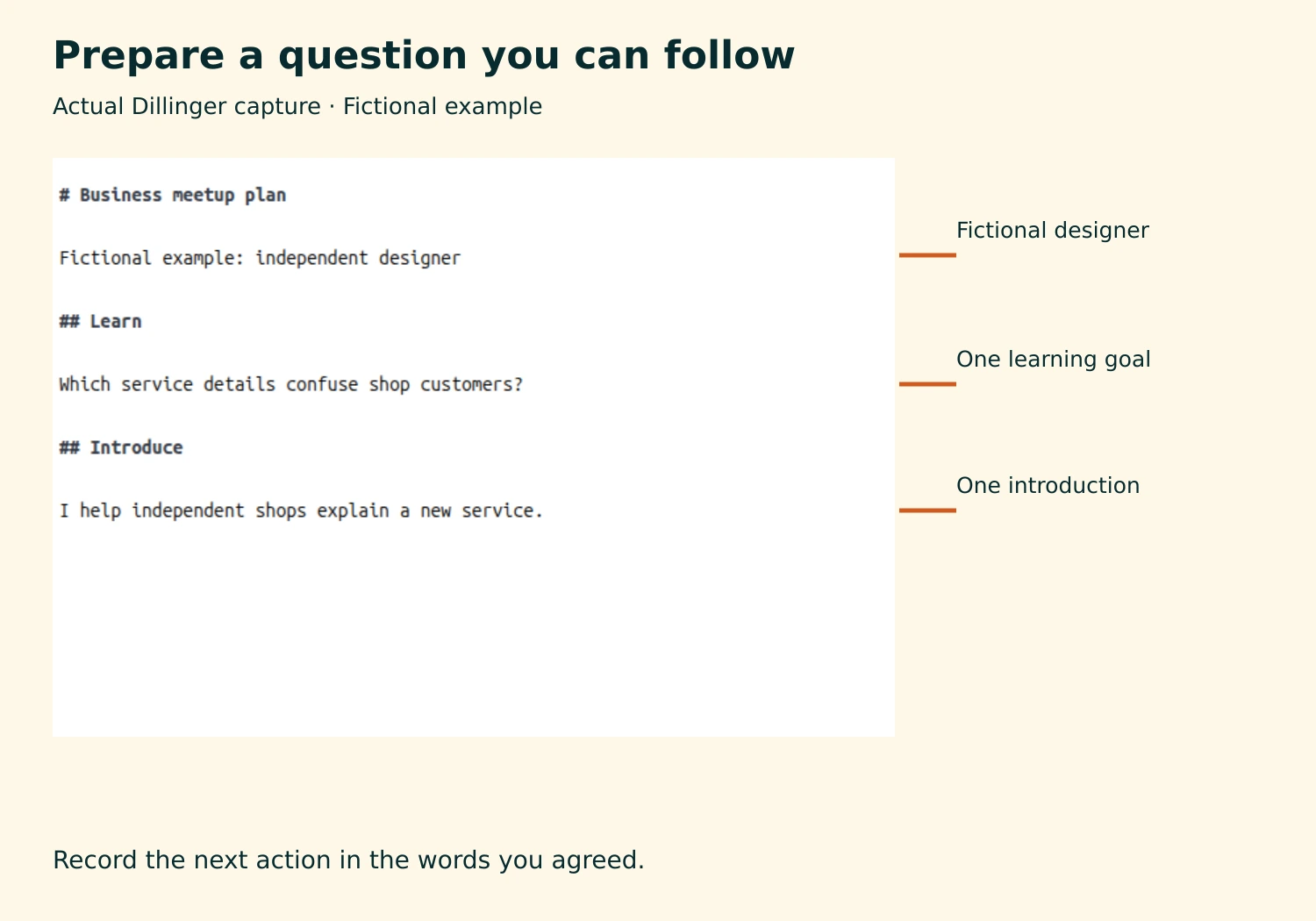
Write one sentence about what you want to learn. A designer might want to understand how independent shops explain new services. A software founder might want to learn which reporting tasks occupy operations managers. A community organizer might want to find people who could teach a workshop.
That goal helps you choose whom to talk with and which questions to ask. It also gives you a way to assess the visit even when nobody asks for a proposal.
You can set a small practice target, such as introducing yourself to two people and asking one follow-up question in each conversation. Choose a number that fits the event and your available energy. This is a planning aid, not a networking benchmark.
A public question from a founder after her first networking event prompted this guide. She found talking about her own business more personal than marketing a client's business. Preparing a few words and a listening goal can reduce the number of decisions she has to make on arrival. The same preparation can help an employee attending on behalf of a company or a freelancer meeting a new professional community.
Research offers some context for treating networking as a skill to practice. A 2020 study summarized by Columbia Business School examined beliefs about networking ability and participation in events. It reported that beliefs about ability were associated with attendance, and that experimentally changing those beliefs affected attendance and participants' experiences. The research concerns motivation and participation. It does not establish that a particular introduction will win clients.
Choose an event where the conversation fits
Read the organizer's description, agenda, participation rules, and access information before booking. Look for evidence that the people and activities match your learning goal.
A shop-services designer might compare a neighborhood business breakfast with a broad startup conference. The breakfast could offer direct conversations with shop owners. The conference could suit a different goal, such as meeting software partners. Ask the organizer about the typical audience when the description leaves this unclear.
Check the format as well as the subject. A talk with a short departure window offers different opportunities from a workshop with shared exercises or a hosted introduction session. Check the total cost, including travel and time away from work. Decide how long you can stay and where you can take a break.
The Western Museums Association's networking guide connects preparation to conference sessions and topics, encourages breaks, and describes ways to enter and leave conversations. Its advice is written for museum professionals; the planning principle also applies to other professional gatherings. Use the actual event's rules and schedule to choose your approach.
For an industry conference, pick one session that supports your learning goal and leave room to discuss it afterward. For a local mixer, ask the host whether there is a first-timer introduction. For an online roundtable, check whether participants can speak, use chat, or join small groups. An event whose only interaction is a sales presentation may give you little opportunity to learn from peers.
Prepare an introduction someone can follow
Use ordinary words to describe whom you help and the work you do. Keep an example ready if someone asks for more.
A fictional designer could say: “I help independent shops explain new services through their websites and printed materials.” If asked for an example, she could describe making workshop options easier to compare. A software founder could say: “We make a tool that helps operations teams track what happens after a meeting.” A community organizer could say: “I arrange practical classes for people starting neighborhood businesses.”
Read your sentence aloud. Replace terms that need another explanation. Ask someone unfamiliar with your business what they think you do. Their answer can reveal a gap between the words you intended and the meaning they heard.
Keep the introduction available in a notebook or on your phone. You can glance at it before entering. If the event provides formal introductions, check the time limit and adapt the sentence to it.
Start with the shared setting
An opening tied to the event gives the other person something concrete to answer. You might ask what brought them to the session or which part of the workshop relates to their work. Listen for a detail you can follow.
For example, a shop owner says visitors often misunderstand the difference between two classes. The designer can ask what people need to know before booking. That question follows the owner's account of the work. It may reveal a communication problem the designer understands.
Tufts University's networking question guide recommends preparing questions and considering whom you want to meet. Its examples explore people's work and experience. Adapt that approach to the person in front of you, then give them time to answer. A prepared question is a starting point for a conversation.
Share your own work when it connects to what they have said. “I recently made a comparison page for a workshop concept” gives them a concrete example, provided you label concept work accurately. If there is no relevant example, continue listening or explain that you are learning about the subject.
A conversation also needs an ending. You can say, “Thank you for explaining that. I'm going to join the next session.” If you have discussed a specific resource, ask whether they would like you to send it and which channel they prefer. Leave an introduction to another person for a moment when both people want it.
Record the agreed next step
After the conversation, save a short note about the topic and any action you agreed to take. Keep details limited to what you need for that action. Check the note before sending anything, especially when several conversations covered similar subjects.
In our fictional example, the shop owner explained that visitors confuse the two workshop levels. They asked the designer to send a booking-page checklist by email. The note records that request. It also records that no newsletter signup was requested, so the designer can keep those actions separate.
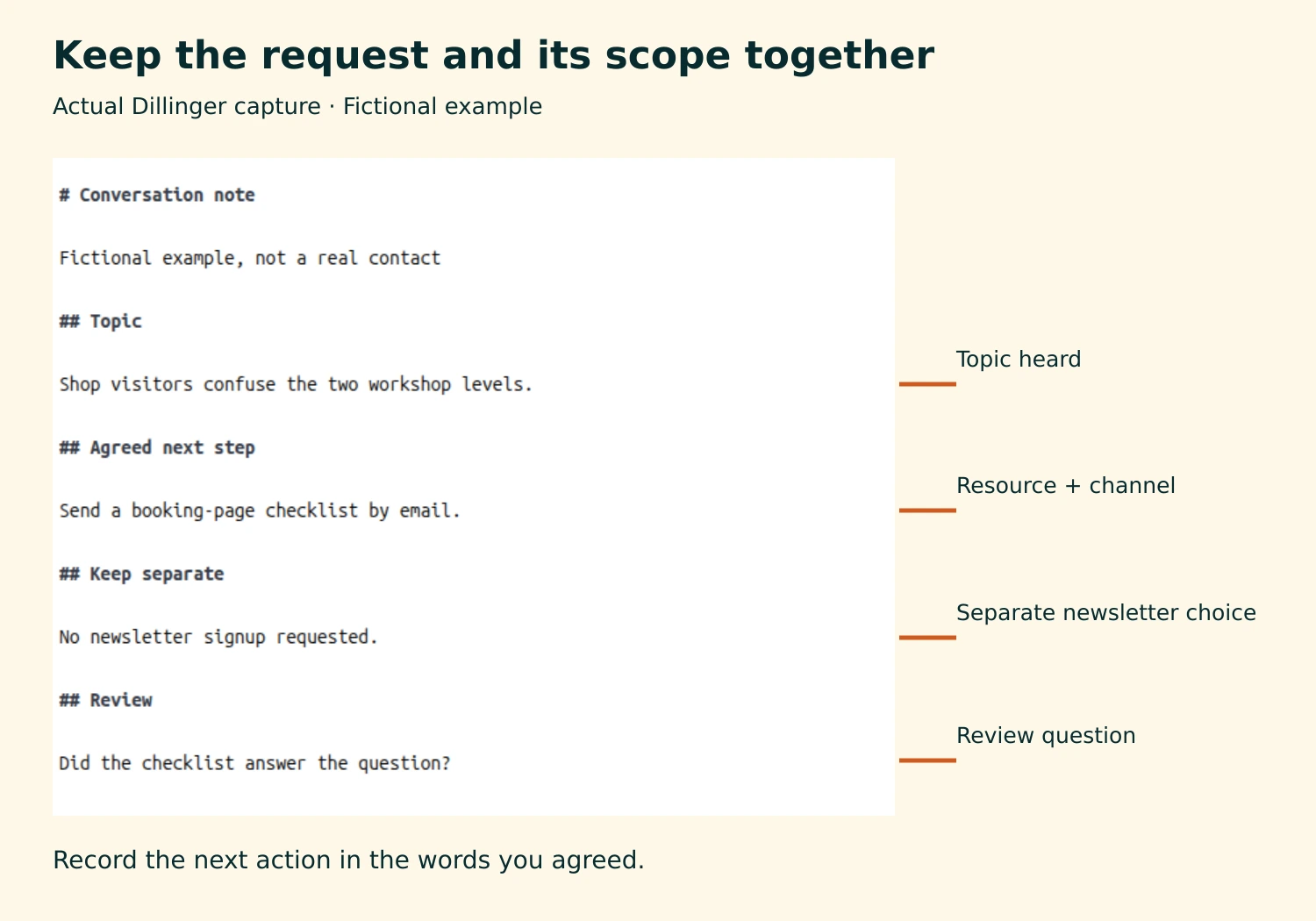
We prepared the demonstration in Dillinger's public Markdown editor. Markdown is plain text with formatting marks, such as a hash sign for a heading. On the date checked, basic editing and preview were available with no signup or payment. We imported clearly labeled example files and captured the actual interface. A notebook or ordinary text editor supports the same process; cloud connections are optional.
Start with your learning goal and introduction. Add the question you want to ask. After the event, create a separate conversation note containing the topic, requested resource, agreed channel, and next action. Read it as a future version of yourself who has forgotten the conversation. It should explain what you promised to send.
Follow up on the conversation
Send the item you agreed to provide, using the channel the person chose. Mention the specific conversation so they can place the message. Keep a further request separate and easy to understand.
A fictional follow-up could read: “At the shop-owner meetup, you mentioned visitors confusing the beginner and intermediate workshops. Here is the booking-page checklist you asked for. The section on comparing options relates to that question.”
If the person wants to discuss a project, ask for a separate time and describe what that discussion would cover. If they only requested a resource, deliver the resource. Exchanging contact details for that purpose does not by itself establish a request for recurring marketing messages.
UCSF's follow-up guidance starts by asking why you want to remain in contact, then offers different approaches for appreciation, learning, or collaboration. Although written for students and researchers, it illustrates why a follow-up should fit the relationship and the conversation. A resource request, a possible collaboration, and a conversation that ended politely can each lead to a different next step.
Review the visit against its goal
Record the total time and cost, what you learned, agreed actions completed, and conversations that continued. Keep those observations separate from later business outcomes.
Suppose the designer spent three hours including travel, spoke with two shop owners, and learned that class descriptions caused repeated questions. She sent one requested checklist. Those are observations from the visit. They can inform a clearer service example or a future article about booking information. They do not establish that the event generated revenue.
If a project inquiry arrives later, record the person's account of how they found you and which conversations or materials they remember. Other influences may have contributed. Keep the event in the history of that relationship and preserve those limits when reporting results.
Use the record to choose the next action. Return to an event whose conversations fit your goal and whose cost you can sustain. Try a smaller or more structured gathering if the format made discussion difficult. If people understood the subject but could not place your service, revise the introduction and test it with a colleague before the next visit.