
A local leaflet drop can introduce your business to people who live close enough to visit. Before you order a stack of leaflets, choose a small delivery area and work out how many visits, orders or bookings would cover the cost. After delivery, record the responses you can trace and check how they compare with your usual business.
Choose an area your customers can reach
Start with where people already travel from. A weekend sauna might look at the areas that current guests name when booking. A bicycle repair shop could begin with neighborhoods that have a straightforward ride to the workshop. A bakery promoting weekday lunch could test a few blocks around office buildings. Use approximate areas and travel times. Neighborhood totals are enough for this stage.
Then choose the distribution method. A postal route can cover a defined area. A local distributor may be able to cover fewer streets, and a shop or venue may agree to display cards. Ask whoever will deliver the leaflets for the boundaries, the number of addresses, the delivery window and a way to confirm the work. If you get quotes for solo delivery and delivery alongside other leaflets, compare their total costs for the same area. Paying for a solo drop gives you a separate delivery. Its effect on response is a question you can test.
Check the provider's current specifications before printing. The UK and U.S. services below illustrate two ways to choose a delivery area. Other markets have their own formats, minimums and rules. Ask the venue or local authority about permission if you plan to hand out leaflets or leave them on display.
Royal Mail Door to DoorCheck the UK delivery service and its booking options.↗ USPS Every Door Direct MailCheck U.S. route planning, piece sizes and retail mailing limits.↗Work out the booking threshold before you print
Add design, printing, delivery and any staff time you want the campaign to cover. Then estimate what an extra completed booking leaves after the costs of serving it. That amount is the booking's contribution. Account for an introductory discount in the booking price so you count it once.
Suppose a sauna has quiet Sunday spots to fill. The fictional print and delivery test costs £180. Each £28 booking leaves £18 after £10 in costs that rise with each booking. Divide £180 by £18. The test needs 10 additional completed bookings to cover that spend. If the division gives a fraction, round up. The screenshot shows the calculation in a browser calculator.
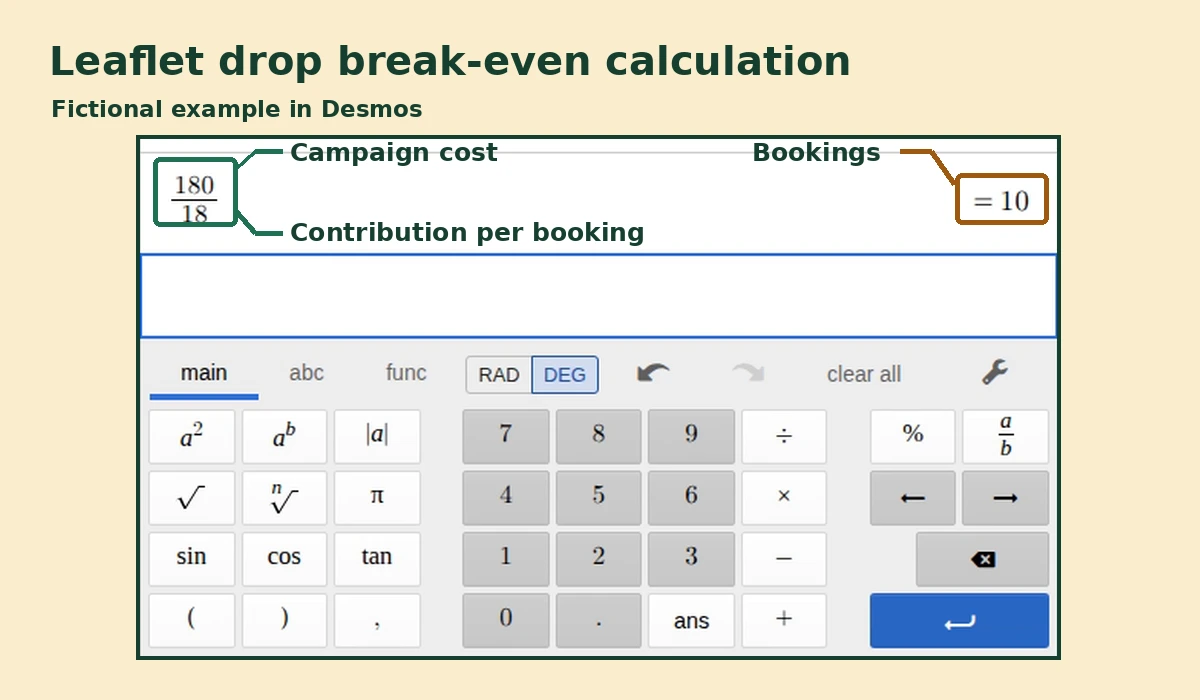
Put that number beside your available capacity. If you can serve six more Sunday bookings during the test, choose a smaller drop or a longer booking window. For a restaurant promoting a weekday lunch, use the contribution from a typical qualifying order. For a repair business with quotes and a longer sales cycle, record qualified inquiries now and set a later date to check how many become completed jobs.
Some businesses can afford a first drop as a learning expense. If you want to learn whether people recognize the offer or can find the booking page, write that aim and the amount you can spend beside the break-even number. Decide in advance what evidence would make another round worthwhile.
Give people a response path they can use
Put the offer, place and next action on the leaflet. For the sauna that could mean a short first-visit description, the location, and a way to see Sunday availability. Print a short readable address alongside any QR code. Check a printed proof on a phone. Follow the link through to the real booking step and try the short address by typing it.
Give each batch a distinct link or a simple code. A second neighborhood might get a different code even if everything else on the leaflet is the same. If people can ring or walk in, ask staff to record the code when a visitor mentions it and ask new customers how they first heard about the business. Keep that answer as a separate field. Someone can see the flyer and later find your name through a search or ask a friend for directions.
If your landing page uses Google Analytics, campaign tags are labels added to the URL so you can see visits associated with the printed link. Use a consistent campaign name and a distinct source label for each route or batch. Check that the link works through any redirect. Keep the count of tagged visits separate from confirmed bookings, and use a booking reference to count a customer once if they both use a link and give a code.
Google Analytics guidance on campaign linksSee how to label the destination URL and check the traffic report.↗Compare the result with a typical week
Record the pieces delivered and the delivery date. Pick a response window that allows time for the offer to be used. Then look at visits to the leaflet page, inquiries, and completed bookings separately. Count total bookings in the delivery area where you have that information. Compare with a similar period before the drop, or keep a similar area for a later drop and compare both areas over the same weeks. Note changes such as a holiday, a sellout, or a price change.
A code or tagged link connects a response to the leaflet. Some coded customers might have booked anyway. Some people influenced by the leaflet will book through another channel. A similar comparison area helps you estimate how many bookings the area might usually bring, and small samples can swing on a few bookings.
Say the sauna records eight completed bookings tied to the leaflet. That is £22.50 in campaign cost per recorded booking. At £18 contribution each, those eight bookings account for £144 against the £180 spend, assuming they were additional. If total Sunday bookings barely changed, check whether regular guests used the leaflet code. If many people reached the booking page and few booked, test the page on a phone and check the available dates. If there were few visits and delivery is uncertain, confirm where and when the leaflets went out before changing the offer.
For the next round, keep the offer and artwork steady if you want to learn about a new area. Keep the area and offer steady if you want to see whether clearer directions or a shorter booking path helps. Change the part your first test gave you a reason to examine.