
A specialist tour operator wants to reach travelers who ask an advisor to plan their trips. The advisor can spot a fit, explain the itinerary and introduce the traveler. A marketer working for the operator can improve the website and run a campaign to find those same travelers. Both can help buyers discover the trip. Each takes responsibility for a different part of the route.
A referral partner introduces a buyer to your business. A distribution partner may also list your offer, package it with other services or handle the sale. Start with the moment someone needs your offer. Then find the person or organization already present at that moment.
Find the buyer’s route to you
Ask recent buyers where they went when they started looking. Record the first source they remember, the person they asked for advice and what they needed to know before taking the next step. A buyer might remember a museum lecture, ask a travel advisor for confirmation and later book through the operator’s website. Each source helped in a different way.
Put the moment in a sentence you can use to screen partners. For an archaeology trip, it could be “Someone asks an advisor for a guided trip built around field expertise.” For a bookkeeping training firm, it might be “An accountant hears that a new client plans to reconcile invoices in-house.” Use that sentence when you ask a prospective partner how often they hear the question and what they say today. Look for evidence of fit in their public listings, events, audience descriptions or related offers.
Compare partners by the job they do
- An advisor or consultant can recognize a buyer’s need and make an introduction. They need enough information to explain the fit and enough confidence that you’ll handle the follow-up.
- A publication, association or event organizer can introduce the offer to an audience at once. Check the format, what the organizer can share about its readership or attendees, and who controls the signup path.
- A distributor, marketplace or reseller can help people discover the offer and may take the booking or payment. Ask about listings, eligibility, customer support, pricing, cancellations and what buyer information each side can see.
- A marketing contractor or agency can research the audience, create the outreach materials or run the campaign. Write down how they expect to reach buyers and who owns each step. If they offer introductions, ask who makes them and how the relationship works.
The labels can overlap. Tourism Australia describes how a company can fill several roles in travel distribution, from assembling an itinerary to arranging the booking. Map the actual path for your offer. A specialty advisor who talks to buyers every week may be a better pilot than a broad network that requires a listing and provides limited visibility into who sees it.
Tourism Australia’s travel distribution guideSee how advisors, wholesalers and ground operators divide the work. The examples describe Australian inbound travel, and arrangements vary by market.↗Give the partner something they can forward
Make a page or short document that answers the questions a partner needs before recommending you. Include who it’s for, what buyers get, price or a realistic range, availability, limits, proof and a next step. Give the partner a short description they can forward with permission. Assign a person to keep the information current.
For a fictional small-group archaeology trip, the brief could give the guide’s credentials, walking and accessibility details, lodging, departure dates, what the price covers and the operator’s booking contact. The advisor also needs a trade sheet that states commission, the booking path and cancellation terms. Keep materials with partner-only terms out of the buyer-facing link.
The same handoff can fit a software company. A consultant who helps stores set up inventory could share a link to a product demo with supported integrations and setup time. The software company can take questions and follow up on trials. A consultant who wants to deliver the implementation may need a separate agreement with a clear support owner.
Set the terms of a small pilot
Choose a partner, a buyer segment and an action to test. An advisor could forward your page to clients planning a trip. A museum could share it after a lecture. Agree who writes or approves the introduction, who responds and when you’ll review the result. Ask what happens if the buyer already knows you, the booking is canceled or two partners both report the same referral.
Estimate what will be left after the sale. For a fictional workshop priced at $300, a 15% referral fee is $45. If running the workshop costs $160 per attendee, $95 remains before fixed costs and the time you spend supporting the partner. Compare that with a fixed placement fee, a wholesale price or a reciprocal introduction. The numbers change with volume, returns, support and the share of bookings that would have happened anyway.
Track the handoff and what follows
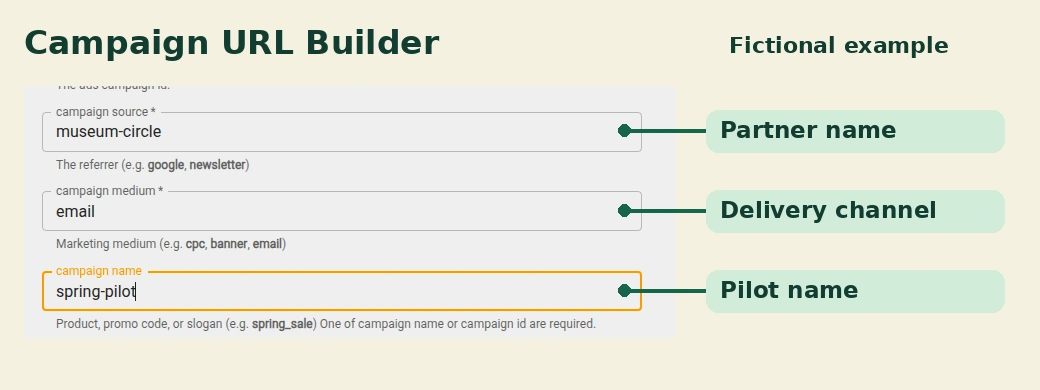
Give each partner a distinct link when buyers click through to you. Campaign tags are short labels at the end of the URL. In Google’s Campaign URL Builder, put the partner’s short name in Campaign source, the delivery channel in Campaign medium, and the pilot name in Campaign name. For a fictional museum newsletter, use museum-circle, email and spring-pilot. Use the same pilot name across links and keep capitalization consistent. Open the finished link to check the destination and confirm that your analytics setup records the tags. Keep names and email addresses out of campaign tags.
Some introductions happen on the phone, in an email or in person. Give those a place in your inquiry log. Ask how the buyer first heard about you and record the answer alongside any link data you have. If you pay for referrals, agree on the record that determines payment. Shopify’s partner documentation gives a real example of tracking a submitted lead through to its status and applying a rule for leads already in contact with the sales team.
Shopify’s partner referral recordsSee how a partner program tracks lead status and defines which referrals qualify.↗At the review, compare what the partner agreed to do with what happened. If the link never went out, check the brief and the handoff. If it went out and people visited but few inquired, inspect the audience fit and the page they saw. If relevant inquiries came in and stalled, read the follow-up notes for recurring questions about price, timing or eligibility. Keep the partner’s observations alongside the numbers. A handful of introductions can tell you what to change in the next pilot. It takes a larger or better-controlled test to estimate how many sales the partner added.