
A small marketing test can help you choose the next audience, invitation or lesson to try. Its meaning depends on who took part, how they reached you and what they actually did. Keep those details beside the result before using it to plan a larger campaign.
Friends, former colleagues and existing customers can help you discover problems in an offer. Their response also reflects relationships and experience that a new visitor may not share. A longer test can collect more observations from the same group. It leaves that recruitment difference in place.
Choose the decision before the metric
Write the next decision in a sentence. A workshop organizer might need to decide whether to offer another introductory class. A software founder might need to choose which kind of operations team to interview next. A consultant might need to check whether unfamiliar readers understand a new service description.
Each decision needs different evidence. Booking a class, explaining a service accurately and returning to use a product are distinct actions. Define the action and its observation period before inviting people. “Interested” needs a description: a person saying they like an idea, requesting dates and completing a booking have made different commitments.
The Cabinet Office's Test, Learn and Grow playbook recommends stating assumptions, observations and decision criteria in a test plan. Its setting is public-service development. The planning principle also applies to a bounded marketing pilot: identify what you believe, what would test that belief and which decision the result could change.
For the fictional class, the question is: “Can we recruit beginners outside our personal network who understand the lesson and complete a paid booking?” The organizer keeps the class description, price, date and booking process fixed for the pilot. They record invitation delivery, visits, bookings and how each participant found the class.
A different question, such as whether people can complete the lesson, needs observation during the class. Booking data alone cannot answer it.
Record who entered the test
Describe the people you intend to learn from through their situation. For a beginner photography class, a screening question could ask when someone last tried to use the camera settings they want to learn. Owning expensive equipment would be a poor substitute for checking that experience.
The Government Digital Service's recruitment guidance starts with actual or likely users and recruitment criteria. It explains that the activity, timing, location and recruitment method can include some people and exclude others. Varying recruitment approaches can help expose those gaps.
Keep a record of the route and any relationship that affects interpretation. A founder's email list, a community newsletter and an open event may reach overlapping people. Someone who receives a forwarded invitation might already know the organizer. A link label alone will miss that distinction.
In a participant record, separate the invitation source from the person's connection to the business. Collect only what the study needs, explain its use and keep identifying details out of shared examples. For interviews or recordings, agree on participation and recording before the session. The GDS consent guidance provides a practical reference for explaining the activity and the participant's choices.
Existing enthusiasts still have something to teach. Ask what they used, what they returned to and what they would do if the offer stopped. Then seek people with the same underlying task through another permitted recruitment route. Record which needs recur and which depend on prior familiarity.
Keep small counts beside their percentages
The fictional workshop pilot records paid bookings during a fixed seven-day window after each invitation:
- Friends and former colleagues: 8 bookings from 10 eligible people invited.
- Unfamiliar people reached through a maker newsletter: 3 bookings from 20 eligible people invited.
The observed booking proportions are 80% and 15%. Together, the records contain 11 bookings from 30 invitations, or about 36.7%. These figures describe this example. They do not establish what another audience would do.
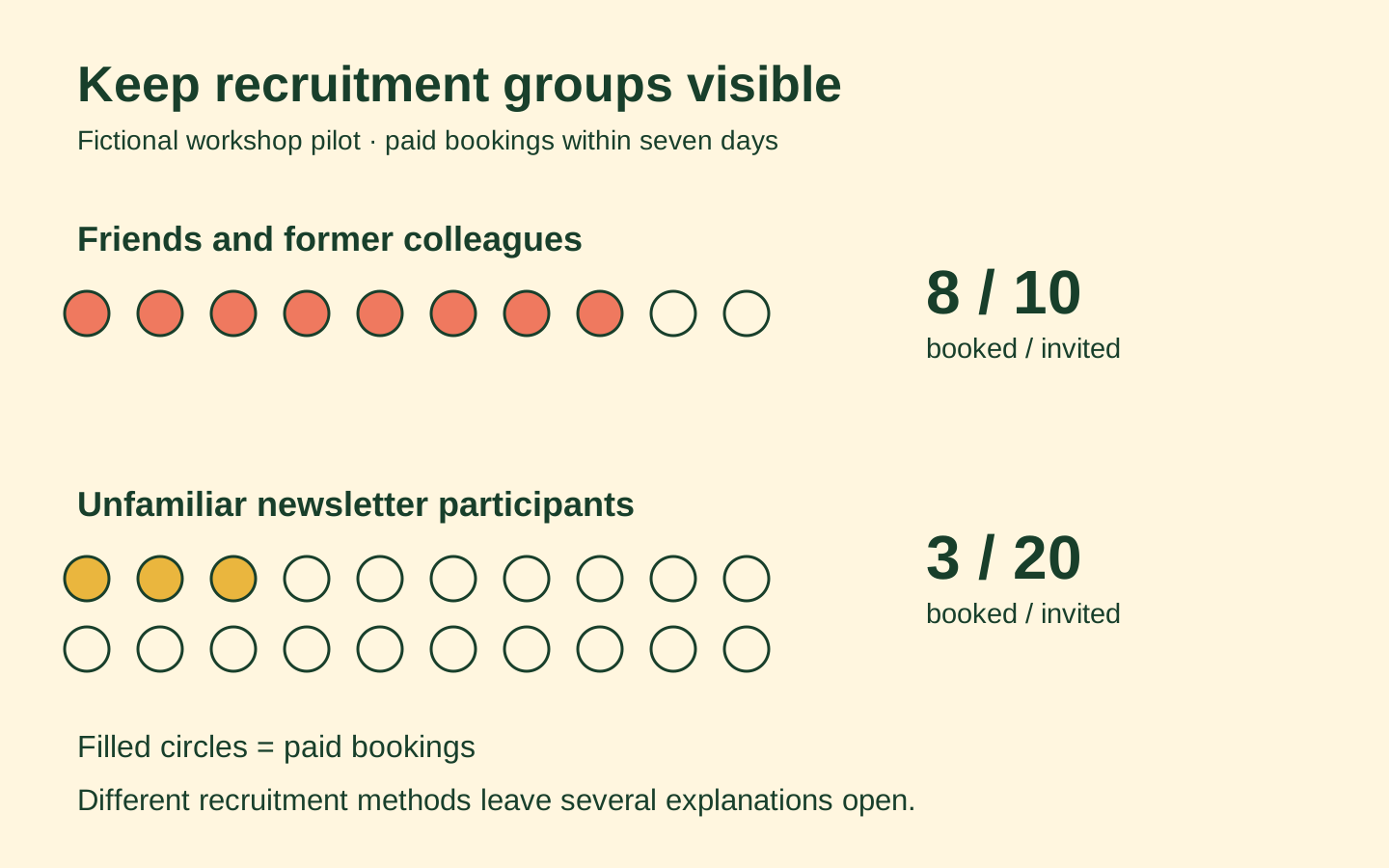
The combined figure hides the recruitment mix. An average of the two percentages would also give the wrong combined booking proportion because the group sizes differ. Calculate the combined proportion from the matching total bookings and invitations, while retaining the separate groups.
The difference between these groups also has several possible explanations. Familiar people may trust the organizer. The newsletter may reach beginners with different schedules. The invitation wording or delivery may differ. This pilot has no random assignment that separates those effects, so it cannot establish which caused the gap.
A change of a few bookings would move these percentages substantially. Statistical uncertainty and recruitment bias are separate problems. The NIST handbook's guidance on proportions describes interval methods and explains limitations of a common approximation with small samples. An interval addresses sampling variation under a statistical model. It cannot correct an audience selected through personal connections.
If you need a population estimate or a comparison between campaign versions, plan the sampling and analysis for that claim. Define the baseline, the smallest difference that would change the decision, assignment method and observation window. A small qualitative round can reveal why an invitation is confusing; it does not supply a conversion benchmark for the market.
Label the invitation route in the actual link
UTM parameters are labels added to a web address. They can help an analytics system identify a campaign's incoming traffic. They do not install analytics, identify every person who saw the invitation or establish that the campaign caused a booking.
We used Google's public Campaign URL Builder to make the example links below. The demonstrated form was available with no sign-in or payment on November 17, 2026. We generated addresses using fictional inputs; we did not send invitations or collect campaign results.
- Enter the example workshop address as the website URL. Substitute the actual page when you run your own pilot.
- Enter
friends_emailas campaign source,emailas campaign medium andworkshop_pilotas campaign name. - Inspect the generated address and save it beside the invitation version and planned destination.
- Change the source to
maker_newsletterfor that publication's invitation. Keep the campaign name consistent so the routes belong to the same pilot.
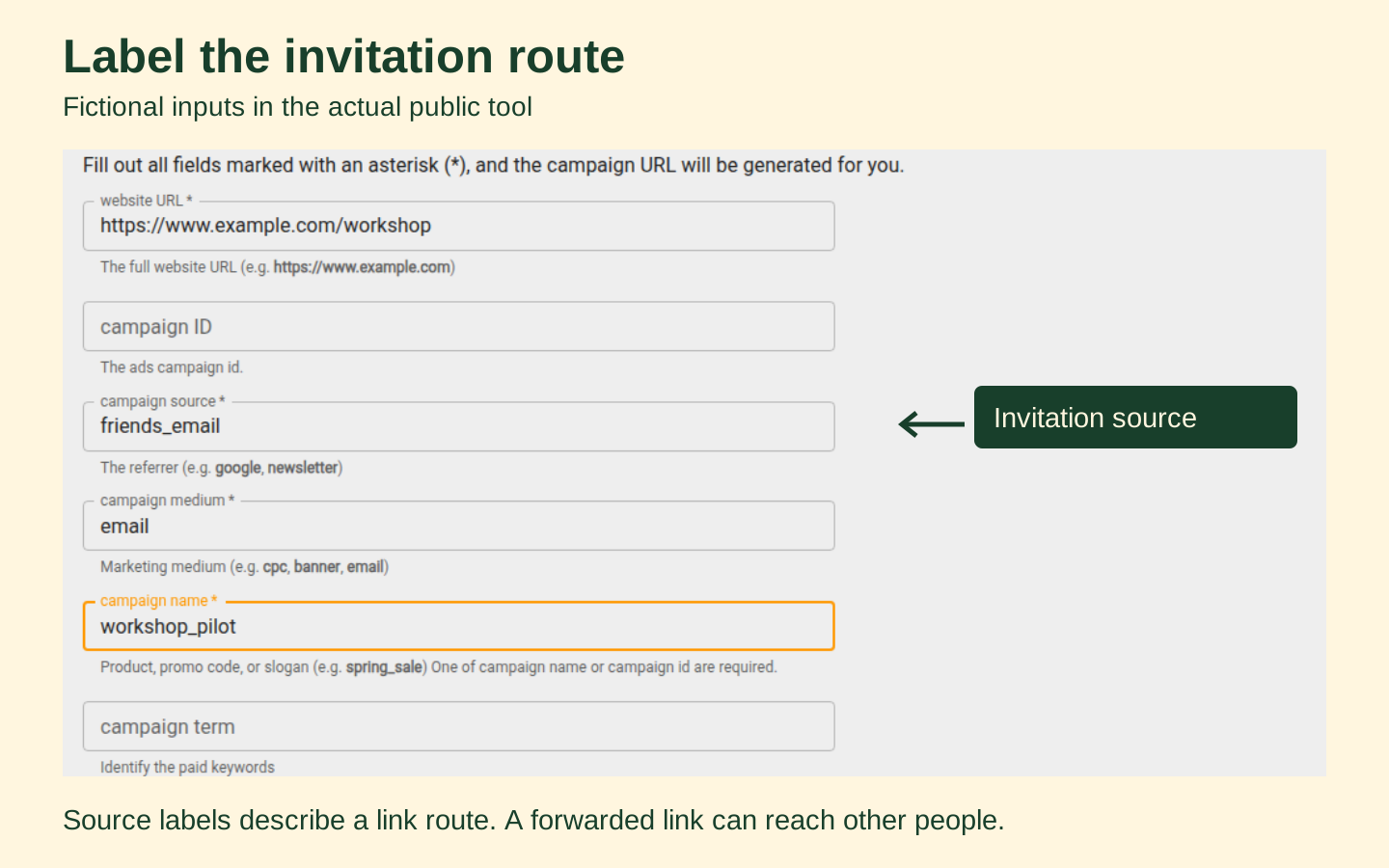
The first generated address contains utm_source=friends_email, utm_medium=email and utm_campaign=workshop_pilot. The second contains utm_source=maker_newsletter with the same medium and campaign. Inspect the final destination before sharing a real link, including any redirects and existing query parameters.
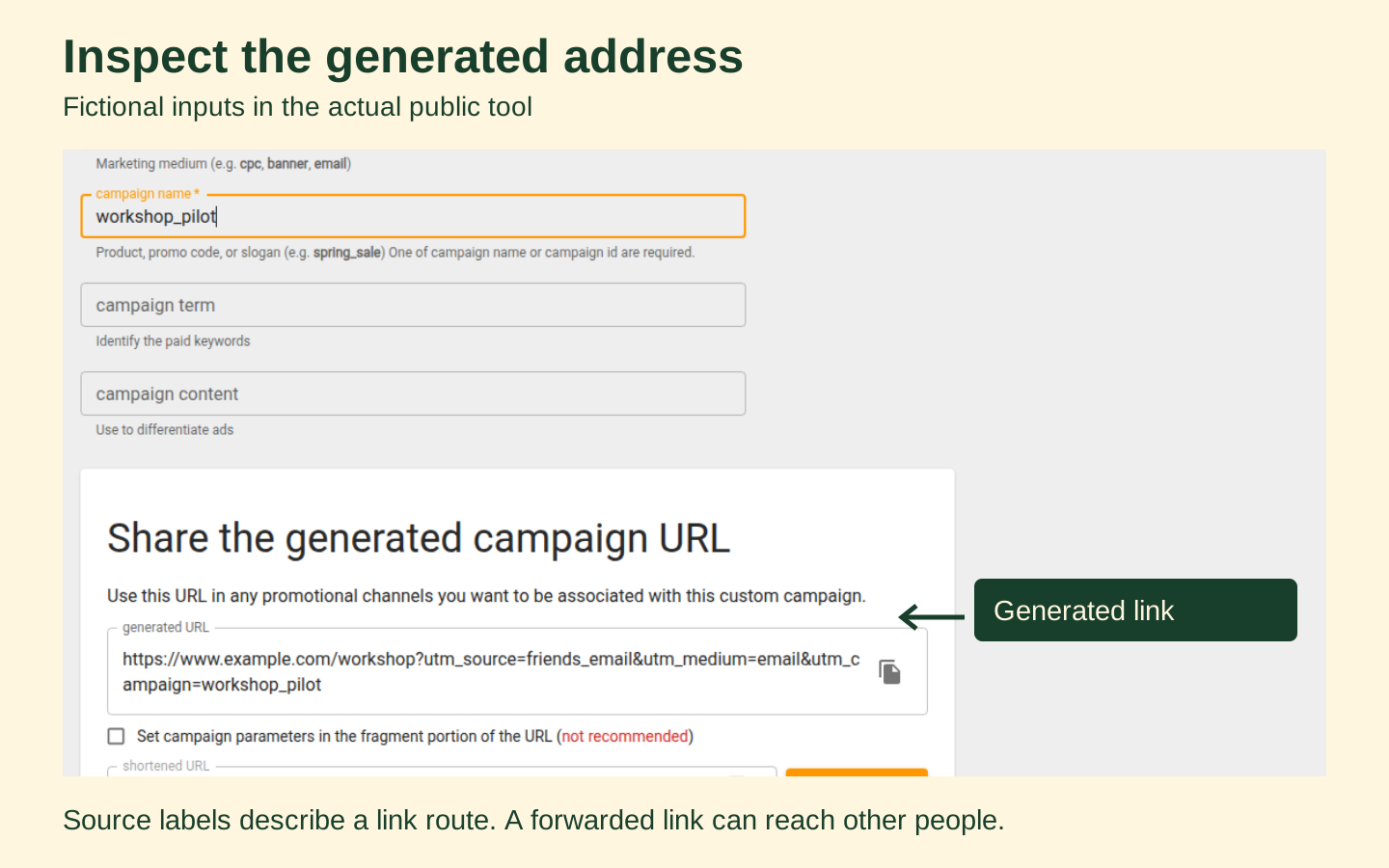
Google's campaign-URL documentation defines source, medium and campaign and explains where campaign dimensions appear in Analytics. It also notes that values are case sensitive. Write a naming convention in the test record so maker_newsletter and Maker_Newsletter do not become accidental separate labels.
Keep names, email addresses and other personal details out of campaign parameters. A recipient can forward the link, and analytics collection can be incomplete. Use the labels alongside the invitation record and any consented participant information. Preserve an unknown relationship as unknown.
Choose a next test that addresses the uncertainty
When the audience is still unclear, start with recruitment and understanding. A software team could invite people who recently handled the same reporting task, ask them to explain the offer and observe their first attempt. Record how each person was recruited, any help given and whether they return for another task. That can guide the next audience description or product change.
When people understand the offer but few act, inspect the route. A class organizer can check the dates, price, travel, accessibility and booking steps with people who considered attending. Ask about what happened during their decision. A polite statement of future interest leaves the booking question open.
When you want to compare creative versions, decide whether enough eligible people can enter a planned comparison while the offer and conditions remain stable. Splitting a tiny audience across several variations may leave every comparison uncertain. A comprehension session can identify a specific wording problem before committing resources to a quantitative test.
When you want evidence about growth, repeat a defined recruitment approach with new eligible people and a consistent record. Keep exposure, visits, completed actions and repeat use separate. A group of enthusiastic users can explain a need in depth. Reaching new people with that need raises an additional question about distribution.
For the workshop, a next-test record could say: “Offer the same beginner class through a second relevant community publication. Keep the offer and invitation version fixed. Record delivery, visits and paid bookings during the same seven-day window, plus recruitment source and known relationship. Cap the fee and preparation time before agreeing to the placement. Review the result before buying another placement.”
That is a proposed test, with its own costs and remaining uncertainty. Success criteria should come from the organizer's capacity and economics. The fictional booking figures above provide no universal threshold.
Report what changed in your understanding
A weekly update can show the assumption being checked, work completed, people reached, observed actions, cost, unanswered questions and next decision. Keep each count's period and denominator visible. Separate an action you can complete this week, such as fixing a broken booking step, from a response you can observe only after participants have had time to act.
This article began with a marketer's question about goals before product-market fit. Product-market fit describes a product meeting a market's needs strongly enough to support continuing demand. The follow-up raised a familiar problem: early enthusiasts may include friends and former colleagues. Workshop hosts, consultants and community organizers face the same interpretation problem in their first campaigns.
If the planned window ends with too little evidence, record the test as inconclusive and state what is missing. Extend it only with a reason, preserving the versions and conditions already recorded. If the audience, offer or delivery changes, start a distinct test record. That keeps the next decision connected to the people and actions you actually observed.
Sources & further reading
- Cabinet Office: Test, Learn and Grow, testing and iterating
- Government Digital Service: finding research participants
- Government Digital Service: research consent
- NIST: confidence intervals for a proportion
- Google Analytics: campaign URL parameters
- Google Campaign URL Builder
- Audience discussion: marketing goals before product-market fit