
A brand name change asks people to connect an unfamiliar name with a business they already recognize. Plan that connection before replacing the signs, profile pictures, or website header. Early customers need to know who is contacting them. Prospective customers need to understand what the business does. Partners need a clear instruction for updating their references.
A startup founder's public question prompted this guide: the code references and website could be changed, but how should a young company carry its first customers through a rebrand? The same problem appears when a local studio changes its name, a service firm expands its scope, or a product becomes a separate business.
The process below is BrandTofu's editorial recommendation for communicating a name change. It assumes the new name has already been chosen and cleared for use. Legal registration, trademark clearance, and changes to contractual or payment details need their own owners and checks. A new trading name alone does not tell customers whether any of those details have changed.
Define what the change means
Write one factual sentence explaining why the name is changing. Then record the changes a customer will encounter and the things that continue. Keep the statements specific enough for someone responsible for the product or service to verify.
For a fictional example, Pine Desk Books is becoming Fieldnote Books because the business now runs reading workshops as well as selling books. The owner, shop, existing orders, and customer contact number continue. The name, website address, and workshop materials change. Those facts give the announcement its substance.
If the business is also changing its audience, offer, ownership, or service terms, explain each change explicitly. A customer should be able to tell which part concerns the name and which part affects their next decision. Resolve unsettled decisions through a named owner; our guide to positioning ownership covers that earlier work.
Two first-party examples show how companies have explained a transition. Wise's February 2021 name-change announcement connects the new name to its wider product scope. It also explains account access, the planned website transition, and changes to its apps and visual identity. The details describe the February 2021 transition.
Kit's public rebranding explanation describes customer research and the reasoning behind moving from ConvertKit to Kit. Its launch announcement connects the new identity with the product direction. These announcements show decisions a company can make visible to its audience. They provide no evidence that the name changes improved awareness or revenue.
Wise: a name change and its customer implicationsThe 2021 announcement explains the reason for the name and what customers would encounter.↗ Kit: explaining the reasoning in publicA first-party account of research, naming, and communication during the transition from ConvertKit.↗Map the places people recognize you
Start with the routes someone uses to find, contact, recommend, or buy from the business. Include the quiet surfaces: an old presentation shared by a partner, the name in a calendar invitation, a receipt, a saved contact, a package insert, or the footer of an automated email.
For each route, write down the old identifier, its planned replacement, the person making the change, the customer action affected, and a way to verify the result. Give each row a live location or file reference. A small spreadsheet or document is enough.
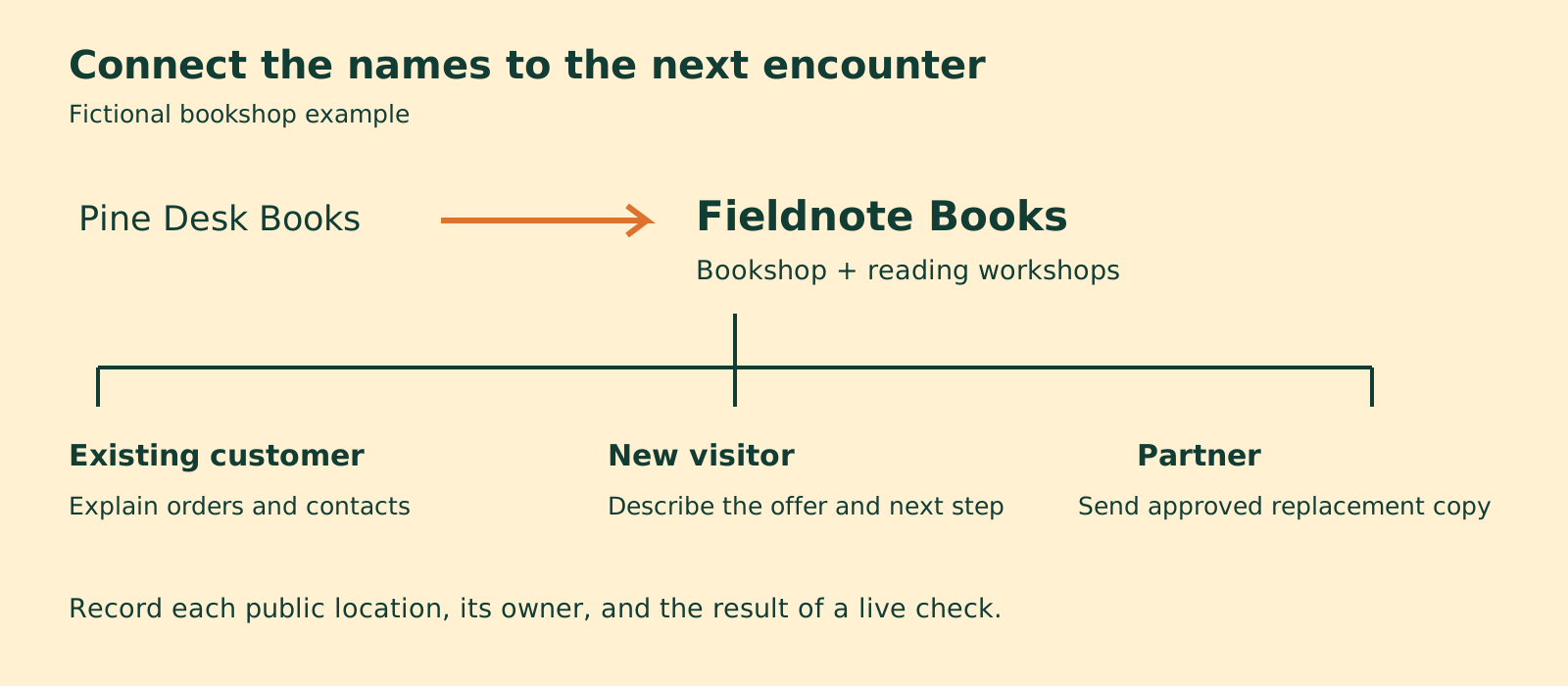
Prioritize by the consequence of confusion. Existing customers receiving an unfamiliar order update need an explanation before that message arrives. A person referred by the old name needs a landing page that confirms they reached the intended business. A partner with a downloadable brochure needs replacement copy and an owner to contact.
For the fictional bookshop, the map includes the shop sign, website, map listing, social profiles, order emails, workshop tickets, and the local library's event page. The owner checks order emails. A colleague checks tickets and the door sign. The library receives a short replacement description and the approved image.
Choose a transition phrase, such as “Fieldnote Books, formerly Pine Desk Books.” Use it where recognition is needed, with the new name clearly leading. Set a review date for each placement. The length of this period depends on how often people encounter the brand; a quarterly workshop audience may need reminders longer than daily users do.
Write an announcement people can act on
The message should connect the names, explain the reason, state the customer implications, and give the next action. Add a place to ask questions. Those are separate jobs, even when a short paragraph does all of them.
Here is a fictional announcement, drafted in a real browser editor. The first draft names the change but leaves the reader to infer its effects.
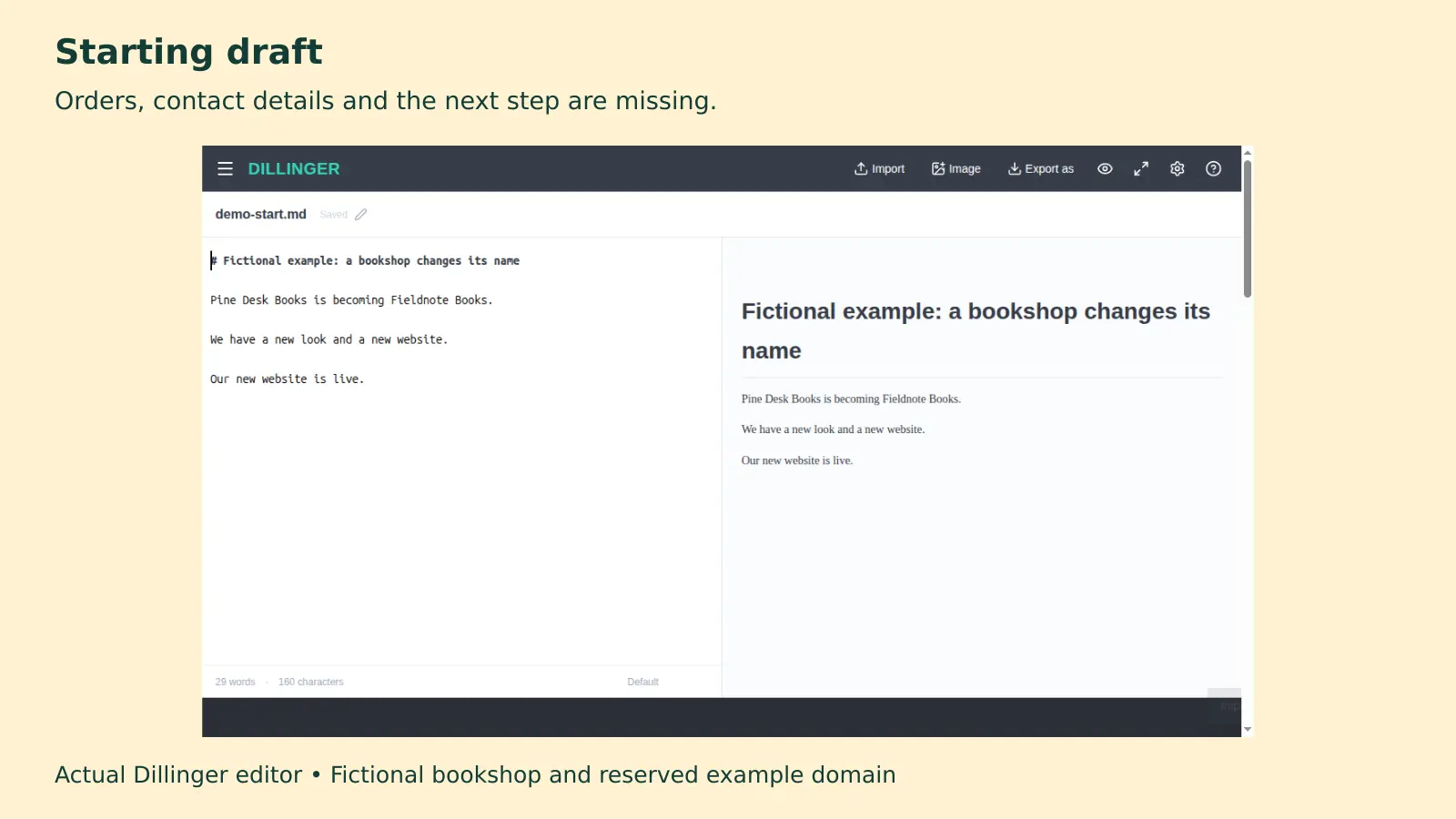
Pine Desk Books is becoming Fieldnote Books. We have a new look and a new website. Our new website is live.
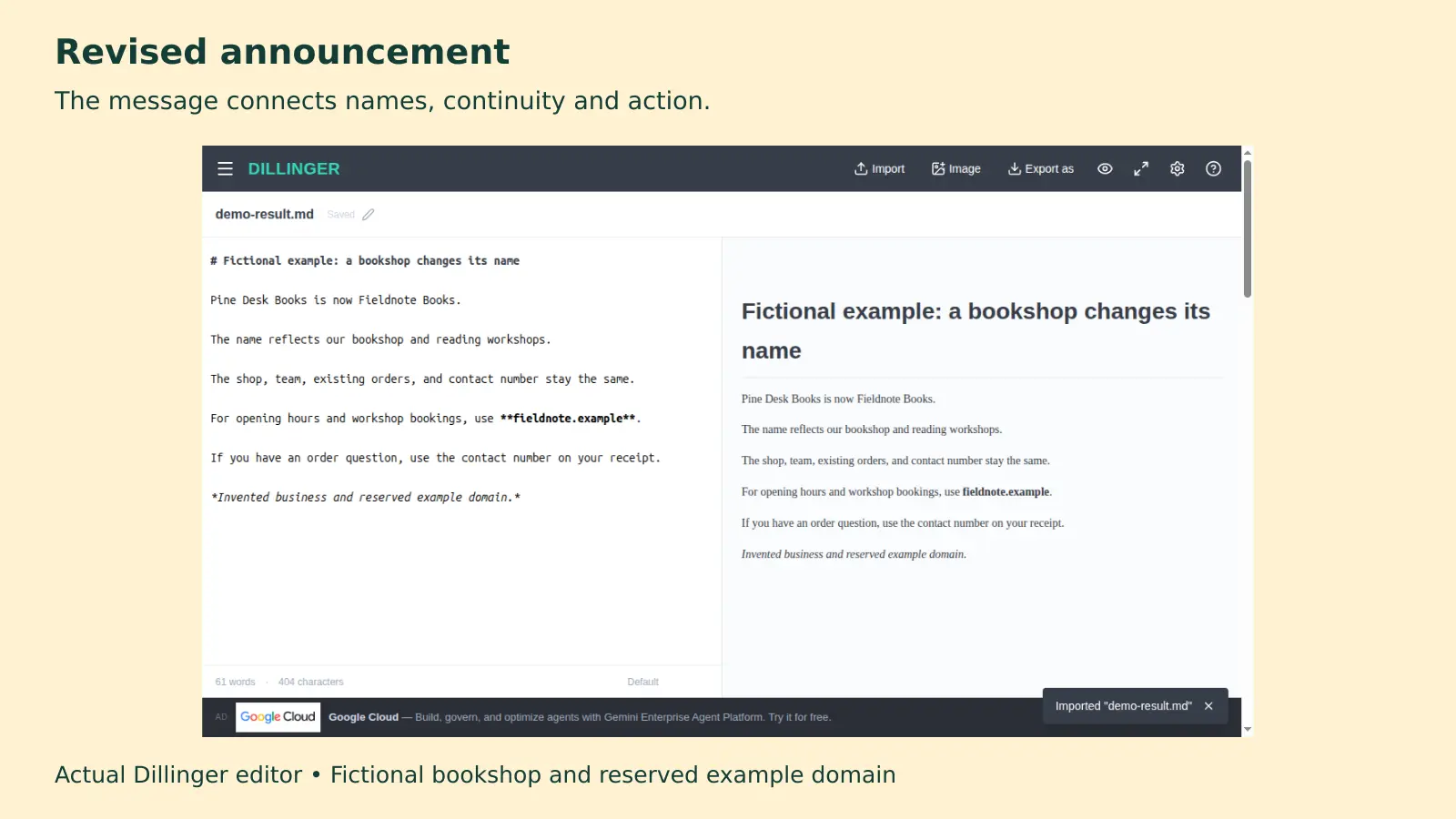
Revise it using verified facts. A finished example could read:
Pine Desk Books is now Fieldnote Books. The name reflects our bookshop and reading workshops. The shop, team, existing orders, and contact number stay the same. For opening hours and workshop bookings, use fieldnote.example. If you have an order question, use the contact number on your receipt.
The example domain is reserved for illustration. The business details are fictional.
Avoid asking customers to infer continuity from the logo alone. If an existing booking is valid, say so after checking. If an action is required, name the action, deadline, and established support route. If prices or terms are changing, give those changes their own explanation.
Sequence the announcement around customer encounters
Brief the people who will answer questions before publishing the public announcement. Give staff and partners the approved wording, the transition date, the affected surfaces, and a route for unresolved questions. Ask them to explain the change back in their own words; differences can expose missing facts.
Then tell existing customers through the channels they already use with you. The timing should let them connect the names before an unfamiliar sign, sender, or interface appears. A small business may need a direct note to a few active customers. A larger audience may need an account notice and an email, with the same facts on a permanent announcement page.
Publish the explanation where new visitors can find it too. Pin or feature it where the platform supports that action. Connect older public references to the explanation when you control them. A teammate should test old links and saved contact routes, record what happens, and fix broken paths through the relevant site or platform process.
After the launch, open the public destinations as a visitor. Check the name, image, contact route, links, and booking or purchase path. Record each result in the map. A changed asset file and a checked live destination are different states.
Adapt the process to the kind of change
A name-only change needs a clear connection between identities and accurate continuity statements. Keep the description of what the business does recognizable. For a consultancy, the line might identify the same team and services while giving the new name and verified contact route.
An expanded offer needs an explanation of the broader work. The fictional bookshop can show one reading workshop alongside its books. A software company can demonstrate the new use case with public example data, while identifying any effect on existing users separately. The product should support the stated reason for the new name.
A product separated from its parent needs a clear relationship statement. Explain who provides it, which support route applies, and which other products are affected. Confirm the facts with the people responsible for those services. “From the team behind…” can introduce the connection, but readers still need the operational details relevant to them.
A merger or ownership change can affect agreements, contacts, and service responsibilities. Assign those questions to the people who can confirm them. Publish a name-change announcement with the facts that are settled, and point to the appropriate explanation for the other changes.
Review recognition and confusion
Choose a review window that includes real customer encounters. Record questions such as “Is this the same company?”, people arriving through the old name, broken contact paths, and partner references awaiting an update. Keep a baseline where available so you can see whether the issue is new.
Ask a few people from the intended audience to read the announcement. Have them explain who the business is, why its name changed, and what they need to do. Record their answers before explaining the intended message. This is a comprehension check; a handful of conversations does not estimate awareness across the market.
Keep distribution counts separate from recognition. A post's reach describes distribution under the platform's definition. Measuring whether people connected the names requires a comprehension or recognition check. A corrected link can resolve a specific access problem. It does not establish that the rebrand increased sales.
At the review date, update the transition map. Retain explanatory wording on surfaces where people still arrive through the old identity. Correct recurring misunderstandings in the announcement and staff notes. Remove temporary wording when the evidence from that route supports the decision, and keep a permanent record of the transition for people who encounter an older reference later.