
Local marketing partnerships help two organizations introduce themselves to people they both serve. A bookshop and a plant shop might run a session about growing herbs. A designer and a printer might explain how to prepare a shop opening. Each partner contributes something the audience can use, and each has a clear role in reaching that audience.
Choose a partner by checking the people they reach, the task you can help with together, and the effort a small test will take. Record what happens before committing to a longer arrangement. A nearby address, a busy event, or a large following gives you a place to investigate. You still need evidence that the partnership fits.
This guide presents BrandTofu's planning process, with fictional examples. It draws on public business-network resources and shows a real directory search. It does not promise a particular number of visitors or customers.
Define the people and the situation
Write one sentence about who you want to reach and when they might need you. Include the area you can serve.
For a fictional bookshop, the sentence could be: “People within a short trip of our shop who want to start growing food at home.” For a business service, it could be: “Independent shop owners preparing their first printed signs and menus.” These sentences lead to different partners, activities, and venues.
A new local business on LinkedIn prompted this guide by asking where to spend marketing time and which networking opportunities could help it become known in a new area. That is a common launch problem: several channels look plausible, and the team has limited time to learn which ones reach the intended people.
Separate two possible audiences. A business network may introduce you to owners who could collaborate with you. A customer workshop may introduce you to residents who could use your service. Write down which audience a particular activity is meant to reach. A room full of potential partners can be productive even when it contains few prospective customers.
Build a short list from places people already gather
Look for organizations that already serve the audience in your sentence. Possible starting points include complementary businesses, trade groups, local business networks, community venues, and event organizers. A complementary business serves a related need: the printer produces the materials that the designer prepares, for example.
The US Small Business Administration's customer-acquisition guidance includes partnerships between businesses with similar customer bases, along with educational sessions and relevant networking. It is a contributor article from 2017. It supplies examples of the approach, not evidence that any particular partnership will produce sales.
For a UK starting point, the British Chambers of Commerce finder lets you search for a local chamber by postcode and distance. Its role in this process is discovery: it helps identify an organization to investigate. A directory listing does not establish that its members match your customers.
Other places to look include a local authority's business-support pages, a trade association's event calendar, and venues that already host activities related to your subject. Read their actual participation requirements. Record where you found each candidate and the fact you still need to confirm.
Check audience overlap and a shared activity
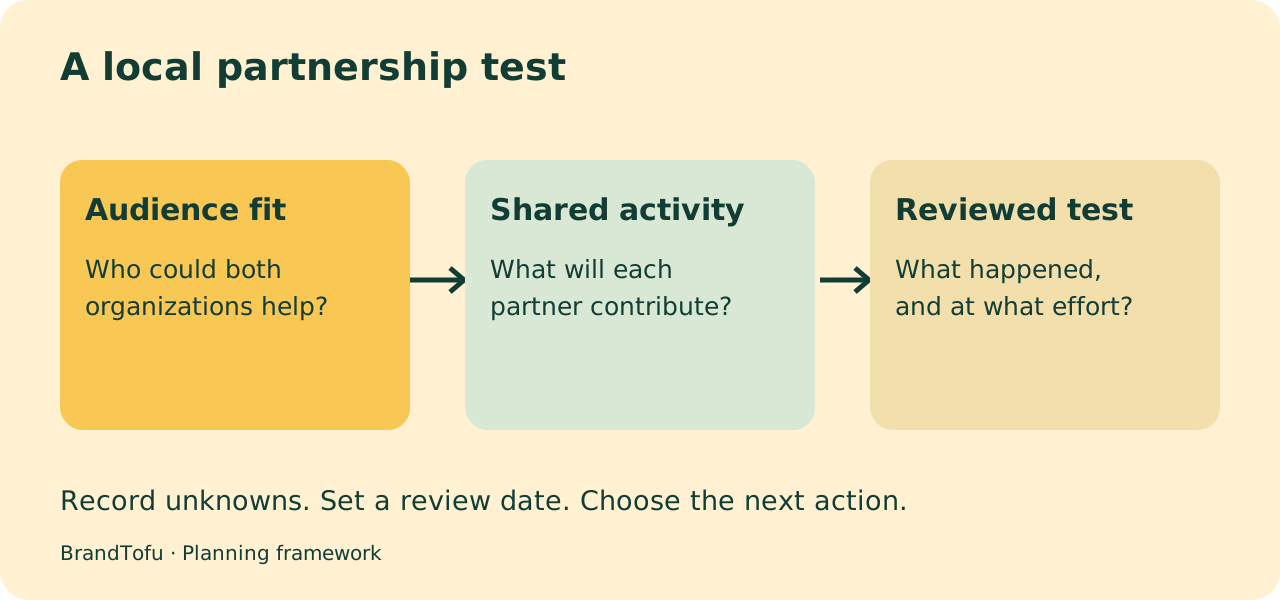
For each candidate, answer these questions in plain language:
- Who does the organization reach, and what evidence supports that description?
- What question or task could the two organizations help those people with together?
- What would each partner contribute and receive?
- Who can approve the work, and how much time and money would a test need?
Keep unknowns visible. “Local followers” does not tell you how many people live within your service area or have the relevant need. A public event description, recent program, or conversation with the organizer can provide a starting point. Ask about the people who usually attend and the format of the event. Do not infer audience characteristics from a venue's prestige.
For the fictional bookshop, a nearby plant shop is a candidate because both could help beginner home growers. The possible shared activity is a short herb-growing session with a book display and a practical demonstration. The audience overlap is still a hypothesis until the shops compare what customers ask and how they would invite them.
A large general business breakfast has a different job. It could help the bookshop meet a venue or supplier. It would need separate evidence before becoming a plan for reaching home growers.
Worked example: find a network and record the next check
We tested the chamber finder on October 19, 2026, using PO16 7SR as a public example postcode in Fareham. The search returned Hampshire Chamber of Commerce among its results. We opened a chamber listing and read the organization's description and website link. The public search required no account or payment during this check.
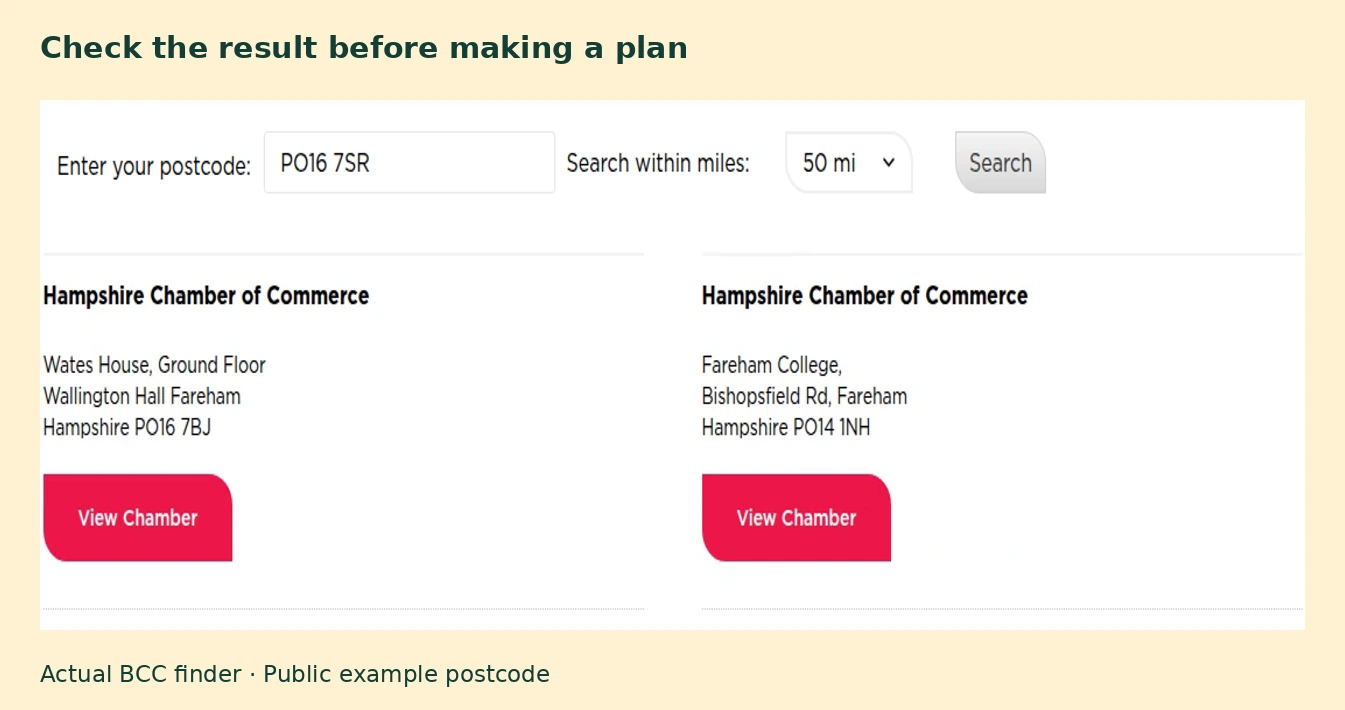
The Hampshire listing on the BCC site describes a membership spanning local businesses of different sectors and sizes, along with events, training, and networking opportunities. That supports adding the chamber to a discovery list. It does not confirm who will attend a particular event or what a guest ticket costs.
The next check is therefore specific: inspect a current event page or ask the organizer about the intended attendees, format, guest access, and total cost. Compare those answers with the audience you wrote down. Follow the organizer's current information when dates, locations, or prices differ between pages.
For another network, Network My Club's event listings describe individual venues, intended attendees, and ticket conditions. Conditions vary by event and membership status. Read the particular event before budgeting or booking. Neither directory is a recommendation to buy membership.
We then used Dillinger, a browser text editor, to write a fictional test plan. Its basic editing and live preview worked with no account or payment during our October 19 check. Any text editor or shared document can hold the same record.
Give one small test a complete brief
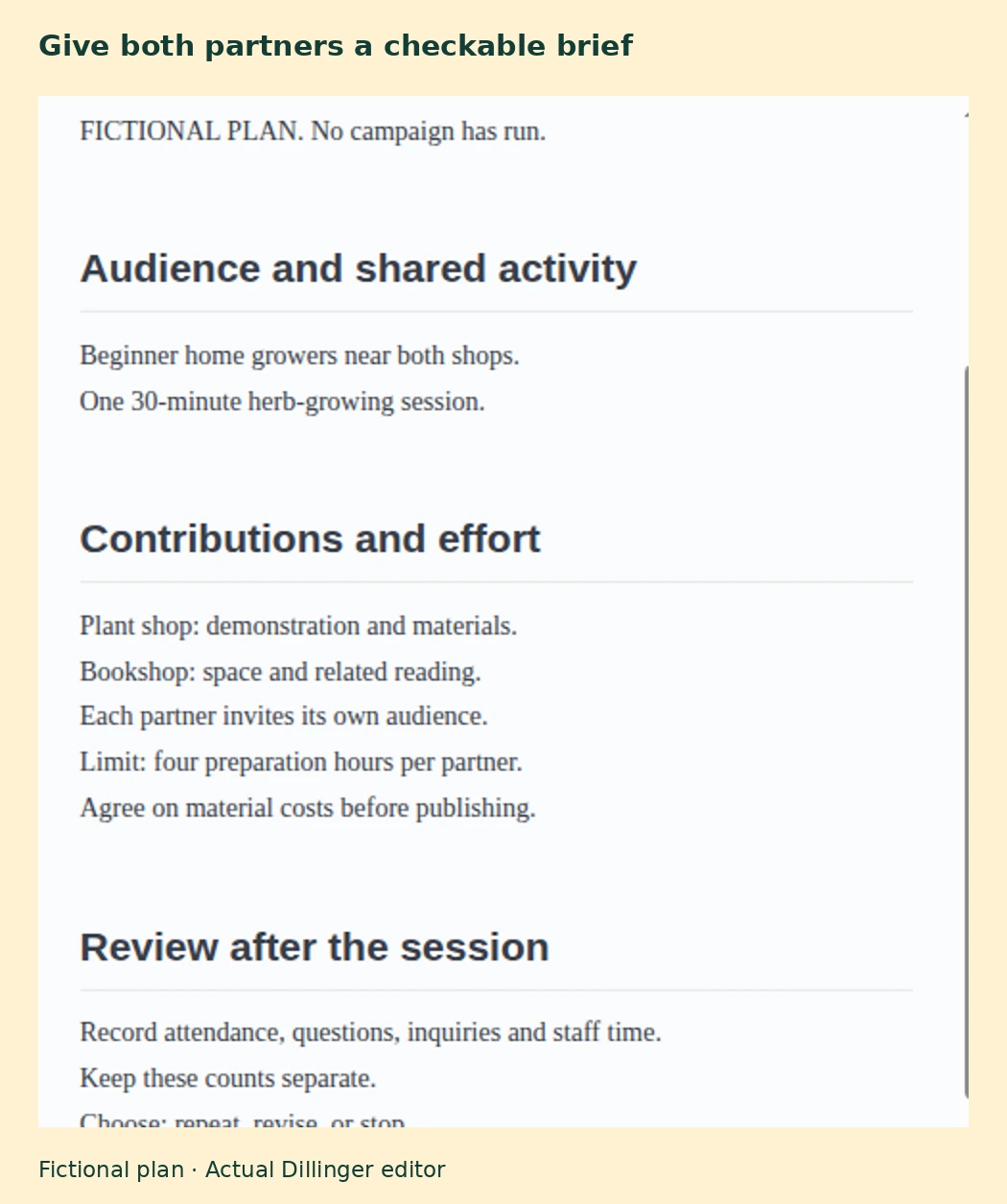
A test needs enough detail for both partners to agree on the work. For the bookshop example, the brief could say:
“Run one 30-minute beginner herb-growing session. The plant shop provides the demonstration and materials; the bookshop provides the space and relevant reading. Each invites its own audience through its usual channels. Cap preparation at four staff hours per partner and agree on material costs before announcing the session.”
Those numbers are fictional planning limits. Set yours from the work and resources available. Include travel, setup, preparation, approvals, delivery, and follow-up when estimating staff time.
Agree on the date, capacity, accessibility, named owners, cancellation arrangements, and who approves the invitation. Explain how each organization will be credited. If money, free products, or other benefits are involved, agree on how those relationships will be made clear. Each partner should check the advertising and professional rules that apply to its own work.
Keep registration and follow-up explicit. For a simple first test, each partner can invite its own audience and direct interested people to a clearly described registration page. Do not treat one organization's customer list as shared campaign material. Agree on the information each partner needs and the permissions before collecting or exchanging it.
The same brief can support several formats. A professional service could run a joint explanation of preparing a print order, using fictional files. A retailer could host a demonstration with a local maker. An event organizer could offer a short educational session with a community venue. Choose a format that lets each partner contribute expertise the audience can inspect.
Review the result against the activity's job
Before the test, decide what you will record and when you will review it. For a workshop, that could include registrations, attendance, the questions people asked, visits to the supporting page, relevant inquiries, and the staff time used. State the counting period and definitions so both partners describe the same activity.
Keep those observations separate. Attendance tells you who came under your counting method. Questions can reveal what people understood or still need. An inquiry is a further action; it may come after several encounters with the business. Ask people how they heard about you when appropriate, and retain uncertainty when they mention several sources.
A tagged link can help identify visits from a particular invitation. It cannot identify every person influenced by the partnership, and it does not establish that the activity caused every later sale. For physical visits, our store-visit measurement guide explains how to keep observed visits, attributed signals, and comparisons distinct.
Use a review date to choose the next action. If the audience fit and the activity produced relevant questions within the agreed effort, consider repeating it. If people attended but misunderstood the offer, revise the invitation or lesson. If the people reached had different needs, investigate another partner or destination. If the effort exceeded the limit, change the format or stop the test.
Record the decision beside the evidence and give the next action an owner. That turns the first collaboration into a record the next one can learn from.
BCC chamber finderUse the postcode search to identify a local business network for further checks.↗ Network My Club eventsRead the audience description and ticket conditions for a particular event.↗