
A partnership-ad offer asks a creator to let a business advertise using their identity. The business gets a way to put the creator’s work in front of more people. The creator agrees to a particular use of their content and name, often in return for payment. Both sides need to understand the permission, the deal, and the evidence they will review.
A creator recently asked on Facebook whether partnership ads are worth doing. That question has several possible answers. A paid trial of a specific video, a broad ongoing advertising relationship, and an offer to work for a share of sales place different demands on the creator. They also give the advertiser different costs and uncertainties.
Start by writing down the proposed exchange. An offer becomes easier to judge when it names the content, the advertiser, the payment, the duration, and the result each side hopes to learn about.
Watch a worked cost calculation in Grist, then compare the questions creators and advertisers need to settle.
What a partnership ad allows
Meta calls these placements partnership ads; its earlier name was branded content ads. An advertiser can promote content with a creator’s or another partner’s handle. Meta’s explanation of creator collaborations describes promoting existing Instagram content and creating new partnership ads in Ads Manager.
A shared organic post and permission to run advertising are separate decisions. Publishing a collaboration gives you a post to review. Before agreeing to paid distribution, establish who can advertise with it, how it may change, and how long that use lasts.
Meta’s current permission guidance distinguishes content-level permission from account-level permission. Content-level permission applies to a particular post, story, or reel. Account-level permission supports a broader relationship: it can allow new ads from the partner’s handle and use of existing content that tags the advertiser. Read the scope shown in your account before accepting a request.
For example, a ceramics creator might agree to a two-week test of a particular glazing demonstration with a named studio. That proposal gives both sides a defined piece of work to assess. A year-long relationship involving new creative needs a wider discussion about approvals, production, and renewals.
Meta: partnership-ad permissionsCompare the current content-level and account-level scopes before accepting access.↗Match the permission to the agreement
Record the arrangement before anyone grants access. A planning sheet can hold these parallel details:
- People and content: the advertiser’s account, the creator’s account, the approved post or assets, and the destination people will visit.
- Permitted use: the platforms, dates, edits, versions, and placements the parties agree to. Decide who approves a changed claim or a new cut of the video.
- Payment and work: the creation fee, paid-use fee if separate, included revisions, payment dates, and the price or process for extending the use.
- Review and stopping: the person monitoring the ads, the reports each side receives, the review date, and the process for ending the campaign and checking access.
These are discussion prompts. Their purpose is to expose an unclear offer while the parties can still change it. For instance, “we may promote your content” leaves the creator unable to judge the workload and duration. Naming the video, a two-week use period, an approved edit, and a renewal decision makes the proposal more specific.
Meta’s content-level permission instructions explain the ad-code and boost-permission routes. They also state that advertisers can edit content for an ad while the original post stays the same. Agree how those ad edits will be approved and save the final version. A correct original post gives you a reference for that check.
The same instructions say that archiving Instagram content does not remove an advertiser’s ad-code access. Use the current permission controls when a relationship ends. Meta documents where to remove account-level and content-level permission.
Judge the offer from the creator’s side
For a creator, the calculation starts with the work and the proposed use of their identity. List the hours for planning, making the content, revisions, approvals, and reporting. Add any direct production expenses. Compare those commitments with the promised payment and its conditions.
A fixed creation fee can be straightforward to budget, but it still needs a defined scope. An offer to pay a percentage of sales needs a clear definition of the counted sales, the reporting source, the payment timing, and how returns or cancellations affect payment. Until you can inspect those terms, the income remains uncertain.
Consider the audience’s expectations too. A specialist who reviews outdoor equipment may be comfortable demonstrating equipment they have tested. A request to endorse a different product, make an unsupported claim, or approve extensive edits creates a new decision. Inspect the actual product and proposed ad before agreeing to attach your identity to it.
Ask about restrictions on other work. An exclusivity term that prevents work with similar companies can affect your future choices. Include the length and scope of that restriction when evaluating the compensation. Decide how additional versions and a renewal will be paid before the first campaign starts.
Calculate the advertiser’s full test cost
For an advertiser, a creator’s fee and the media budget belong in the same planning calculation. Include production or editing costs as well. A report that counts only the money spent showing ads leaves part of the test cost out.
Here is a fictional example in US dollars:
- Creator fee and agreed paid use: $750.
- Production and editing: $250.
- Media budget: $500.
- Total test cost: $1,500.
Suppose the test report later records 300 visits to the destination. Dividing $1,500 by 300 gives $5 per recorded visit. Dividing only the $500 media budget by those visits gives about $1.67. The two calculations answer different cost questions, so label the numerator in your report.
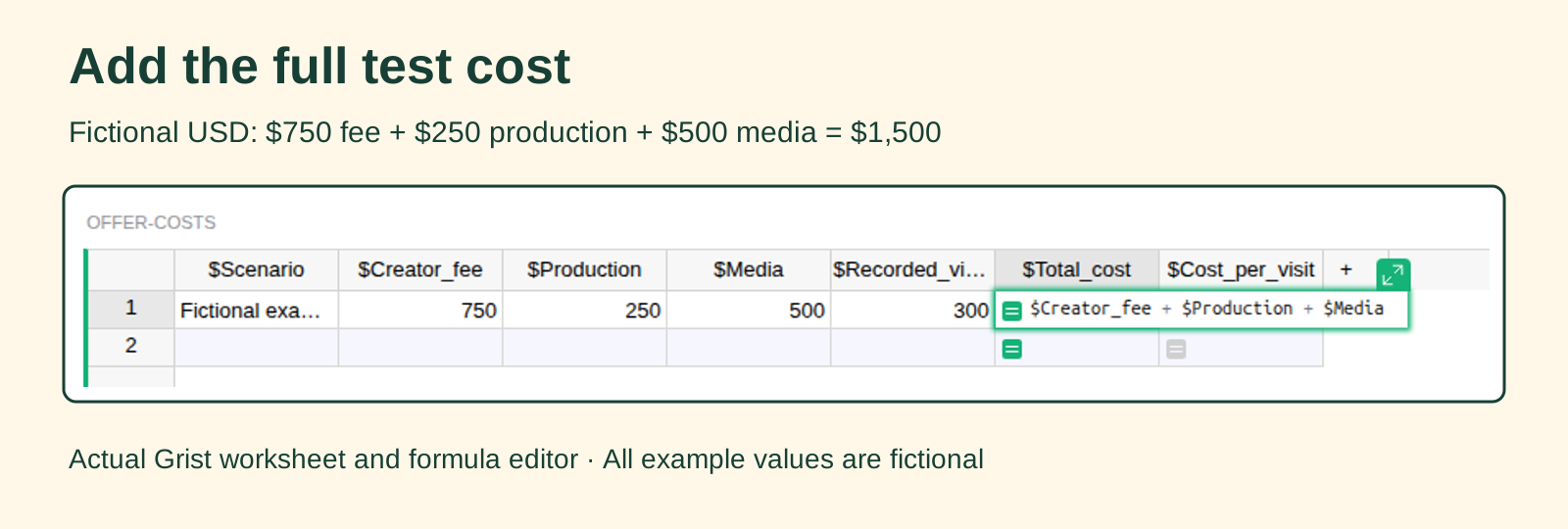
We used Grist’s anonymous editor for this small worksheet on November 4, 2026. The calculation uses $Creator_fee + $Production + $Media, followed by $Total_cost / $Recorded_visits. Grist’s formula documentation explains its dollar-sign column references. You can make the same calculation in a spreadsheet you already use. For a zero-visit result, report the count and cost separately; division by zero cannot give a cost per visit.
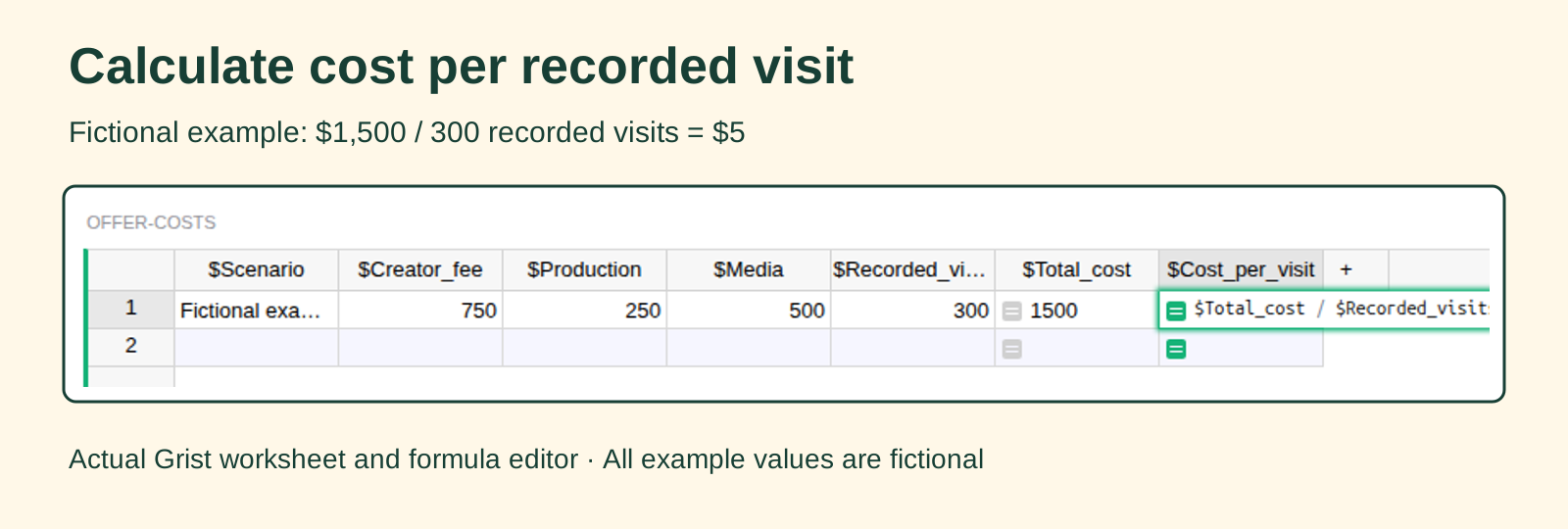
A cost per visit does not establish that the campaign caused every recorded visit. It also leaves questions about visitor fit, subsequent actions, and whether those people would have arrived anyway. Keep the reporting method and its limits beside the number.
Decide what the trial should teach
Choose a learning goal that matches the proposed campaign. A local workshop might want people in its service area to understand a class format and visit its schedule. A business software company might want a specialist creator to explain a task to practitioners. A creator deciding on a paid-use offer may care first about the compensation, workload, and control over the approved message.
For the advertiser, record the intended audience, the promise made in the ad, and the action available on the destination. Review a sample of the creator’s relevant work and the audience information they can share. Follower count alone leaves the subject and audience fit unclear.
Agree which evidence each side can see. Save the approved ad and live link, the spend and delivery report, and the destination’s recorded actions. Keep paid and organic results labeled. If the goal is awareness, describe the intended change in familiarity or understanding and how you plan to observe it. Clicks can help you inspect a response to the offer; they do not directly measure how many people remember the brand.
Our guide to planning a small paid-awareness test develops the budget and measurement plan. The creator-collaboration planning guide covers the shared brief and publication process.
Set the decision before launch
Give the trial an end date, a spending cap, and a scheduled review. Write what would lead you to continue, revise, or stop. You might continue because the message reaches the intended people at a cost you can support; revise because people arrive but misunderstand the offer; or stop because the approved scope has been exceeded.
Keep the creator’s decision separate from the advertiser’s campaign result. A campaign can generate inexpensive clicks while leaving the creator underpaid for revisions. A creator can complete the agreed work while the advertiser discovers that the destination needs improvement. Review each side’s commitments against the agreement.
At the review, compare the evidence with the goal and include the full cost. If you extend the campaign, record the new dates, creative, payment, and permission scope. If it ends, confirm that the ads have stopped and check the remaining permissions in Meta’s current controls.